Buildings & Architecture, Contests & Giveaways, Society

History Lovers Grand Tour & Scavenger Hunt: The Regency Bluestocking’s Date

History Loves Blog Hop

If you were a bookish sort of girl during the Regency period, where would you go on an outing with a gentleman? Assuming you found a gentleman who appreciated a lady with a sharp mind, and a chaperone willing to accompany you, you might make a trip to the British Museum.

British Museum Montague House
An engraving of Montagu House (credit: British Museum)

In 1675 Ralph Montagu (later the 1st Duke of Montagu) bought a piece of property on what was then the northern outskirts of London, and built himself a grand house. When it burned down a few years later he built an even bigger one, more palace than house. Upon the 1st Duke’s death, his son inherited the property, but had no son to follow him. The 2nd Duke’s two daughters inherited the unentailed property when he died, including Montagu House in London. Since both were married with homes of their own neither sister actually lived in the place, and it began to fall into disrepair.

Enter the trustees of the newly-founded British Museum, who were looking for a building suitable for housing antiquities and other collections. They bought Montagu House in 1754 for 10,000 pounds and hired a Mr. Bramley as gardener. Within a year the lawns, gravel walks, and kitchen gardens were restored to their former glory. By 1757, the gardens were open to the public a full two years before the building itself was ready. By 1800, 600 different species of plants had been established on the grounds.

Parthenon frieze
Part of a frieze taken from the Parthenon by Lord Elgin (credit: British Museum)

What would you have seen inside? A big attraction was the Parthenon Sculptures brought to England by Thomas Bruce, 7th Earl of Elgin (popularly known as the Elgin Marbles). On display since 1817, the sculptures were originally part of the Parthenon in Greece, decorating the building as it went from Athenian temple to Catholic church to Muslim mosque. When Lord Elgin took up his post as British Ambassador to the Ottoman Empire, the Parthenon was a ruin. As a way of preserving what was left, he removed statues and friezes from the Parthenon and sent them home to London. This jump-started a craze in England (and the rest of Europe) for all things Greek.

Have you read a Regency novel where a character dressed as a Greek goddess for a masquerade? Have you heard gowns or hairstyles described as Grecian? The Elgin marbles were a large part of this cultural phenomenon. And they are still on display at the British Museum to this day.
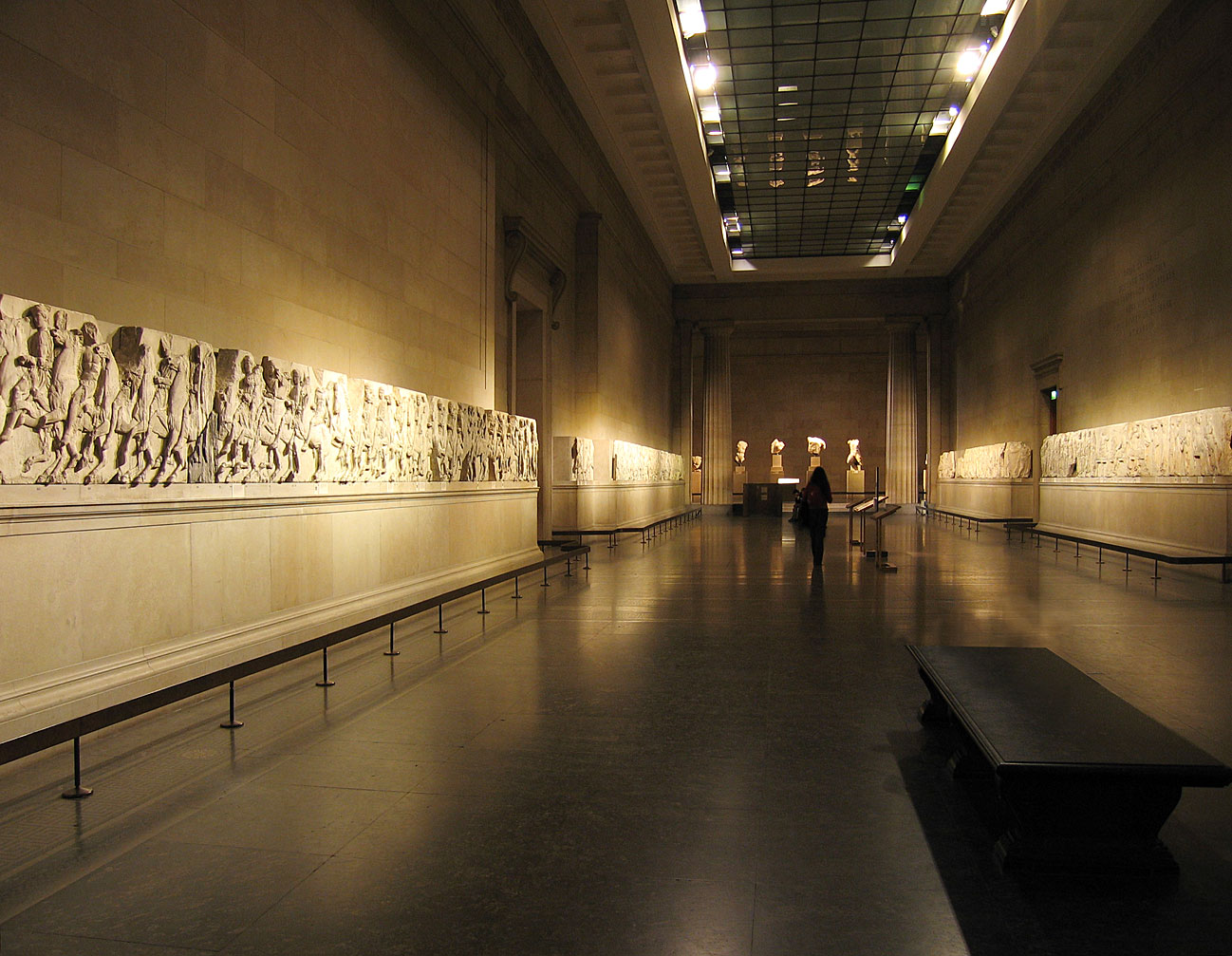
Elgin_Marbles_British_Museum
The Elgin Marbles collection today (credit: Wikipedia)

And now for the giveaways!

Leaving a comment on this post will enter you in my individual giveaway: a 6-pack of credits at Discover a New Love. Each e-book is 1 credit, and they often have books available before their public release. This giveaway is open to anyone in any country, but comments must be left by 11:59 pm EST on Friday, July 26, 2013 to be entered.

We’re also having a Hop-wide scavenger hunt! Just visit each of the websites participating in the Grand Tour, and enter your answers to their scavenger hunt questions here. The entrant with the most correct answers will receive a $50 gift certificate to the book retailer of her choice. This contest is also open internationally, and entries must be submitted by July 26, 2013.

Scavenger Hunt question: What year did the Elgin Marbles go on display at the British Museum?

History Lovers Grand Tour Authors:

Rue Allyn / Amylynn Bright / Collette Cameron / Téa Cooper / Beverley Eikli / Susana Ellis / Aileen Fish / Debra Glass / Amy Hearst / Evangeline Holland / Piper Huguley / Eliza Knight / Kristen Koster / Cora Lee / Georgie Lee / Suzi Love / Denise Lynn / Deborah Macgillivray / Barbara Monajem / Shelly Munro / Ella Quinn / Eva Scott / Shereen Vedam / Elaine Violette

Source: The British Museum, Great Russell Street, WC1B 3DG
http://www.britishmuseume.org
Fashion, Friday Favorites, Society

Friday Favorite: Candice Hern’s Regency World

quadrille

Our Friday Favorite this week is a treasure trove of information. Regency romance author Candice Hern recently revamped her website, and now it’s bigger and better than ever!

Features include:

The Illustrated Regency Glossary

A Regency Timeline

Collections of Regency fashion prints, accessories, and other household objects

There’s even a section called Bridgerton Couture, featuring Julia Quinn’s Bridgerton heroines and their fashion selections.

This is one of those websites you can visit and quickly become absorbed in–an excellent resource for the Regency reader or writer 😀

Regency

Eyeglasses of the Regency

Written by Jacqueline Diamond, whose half-dozen traditional Regency romances, now available as ebooks, include Rita Award finalist THE FORGETFUL LADY as well as LADY IN DISGUISE and A LADY OF LETTERS. Published in the Regency Reader, July 2013.

Since people suffered from visual defects in earlier centuries just as they do now, it should be no surprise that, throughout the ages, inventors, artisans, jewelers and glassmakers put their talents to use improving our ability to see.

The earliest known use of lenses to aid vision was in ancient Egypt and Assyria, where people were depicted using magnifying stones such as polished crystals. In the first decade B.C., Roman philosopher Seneca used water-filled objects to magnify text for reading.

Reading Stone via http://thestoryofmocroscope.blogspot.hu/

Around the year 1000 A.D., Muslim scholar Alhazen (965-1040)-known as the father of modern optics-wrote a seven-volume treatise on the subject. In the late 12th century, Marco Polo claimed that eyeglasses were popular among the wealthy Chinese. The demand for spectacles grew dramatically by the end of the 15th century, thanks to the invention of the printing press and the much wider availability of reading material.

Here are some good sites about ancient glasses:
http://optical.com/eyeglasses/history-of-eyeglasses/
http://www.antiquespectacles.com/history/ages/through_the_ages.htm
http://io9.com/strange-and-wonderful-moments-in-the-history-of-eyeglas-507302709

My own myopia inspired me, for my sixth traditional Regency romance, to create a nearsighted heroine. In A Lady’s Point of View, Meg Linley–forbidden by her mother to wear eyeglasses–accidentally causes a scandal by cutting Beau Brummell at a ball. Then, sent home in disgrace, she gets into the wrong carriage and is mistaken for a governess.

In 1989, when Harlequin published the novel, I had to dig through books for a few snippets of information on eyeglasses during the Regency. Imagine my delight, when preparing the recent ebook release, at finding a treasure trove of information on the Internet.

Here’s a look at the situation that would have affected my heroine:
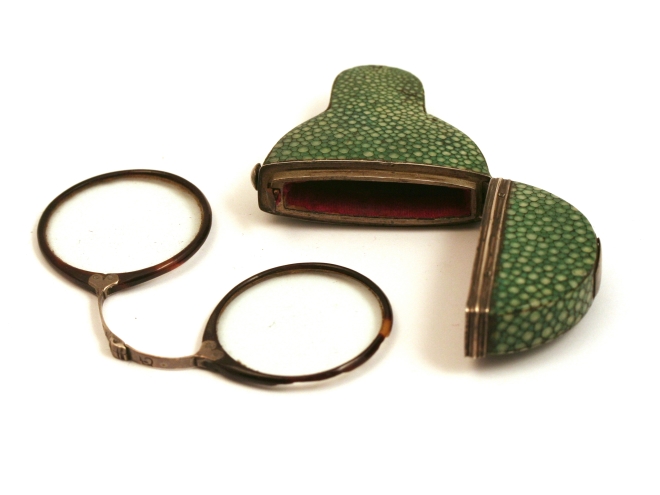
An English optician, Edward Scarlett (1677-1743), is credited with developing eyeglasses that rest on the nose and ears. While the exact origin of bifocals is debated, Benjamin Franklin usually gets the credit. Bifocals were found in London after the 1760s.

Spectacles with tortoise shell and silver rims and a shagreen case, c. 1770 via http://susanewington.blogspot.hu/2012_05_01_archive.html

However, glasses weren’t considered fashionable by the Regency upper crust. Instead, the Beau Monde preferred the quizzing glass, a magnifying lens with a handle that the user peered through.

Quizzing glasses remained popular until the 1830s, when the lorgnette gained in popularity, especially among women. First appearing between 1795 and 1805, the lorgnette is a pair of lenses with a short handle. Also known as opera glasses, these derived their name from the French word lorgner, to ogle.

The quizzing glass was usually set with a magnifying lens, although in some cases a corrective lens was used. Goldsmiths or jewelers provided the frames, often made of gold or sterling silver, with elaborate designs. These hung from a chain attached to the handle-of varying lengths-or loop.

For charming pictures of eyewear from the Regency, I recommend these sites:
http://historicalhussies.blogspot.com/2010/08/regency-glasses-and-eyeware.html
http://candicehern.com/collections/04/eyeglass.htm

Books, Friday Favorites

Friday Favorite: Slightly Dangerous

Description (from Amazon):

“All of London is abuzz over the imminent arrival of Wulfric Bedwyn, the reclusive, cold-as-ice Duke of Bewcastle, at the most glittering social event of the season. Some whisper of a tragic love affair. Others say he is so aloof and passionless that not even the greatest beauty could capture his attention. But on this dazzling afternoon, one woman did catch the duke’s eye—and she was the only female in the room who wasn’t even trying. Christine Derrick is intrigued by the handsome duke…all the more so when he invites her to become his mistress.

What red-blooded woman wouldn’t enjoy a tumble in the bedsheets with a consummate lover—with no strings and no questions asked. An infuriating lady with very definite views on men, morals, and marriage, Christine confounds Wulfric at every turn. Yet even as the lone wolf of the Bedwyn clan vows to seduce her any way he can, something strange and wonderful is happening. Now for a man who thought he’d never lose his heart, nothing less than love will do.”

This is one of my favorite books of all time! Like The Madness of Lord Ian Mackenzie, Slightly Dangerous at first appears to be like any other Regency romance. The beauty in this story, though, is its leading man, Wulfric Bedwyn. He is every inch the cold, formidable duke in public (and sometimes with his siblings). But throughout the previous five books, the reader gets tiny peeks at the man under all that ice. You see his loneliness and isolation, the way he adores his family even when he can’t (or won’t) tell them. You discover little pieces of his soul.

I fell in love. And then, so did he 🙂

http://www.amazon.com/Slightly-Dangerous-Balogh-Mary-ebook/dp/B000FC1PBG/ref=tmm_kin_title_0?ie=UTF8&qid=1371758779&sr=8-1

Slightly Dangerous

Books, Friday Favorites

Friday Favorite: Richard Armitage Reads Georgette Heyer

Hold on to your e-readers and mp3 players, ladies! Our Friday Favorite this week is Richard Armitage. He’s best known for his portrayal of John Thornton in North and South, Lucas North in MI-5 (Spooks across the Atlantic), and most recently as Thorin Oakenshield in The Hobbit movies.

Richard Armitage

But in the last few years he’s also gotten into audiobook narration, including three of Georgette Heyer’s novels: The Convenient Marriage, Venetia, and Sylvester.

Audio clips:

Interview for The Convenient Marriage, where Richard talks about the difference between doing audiobooks and screen acting, and his love of music. (June 2010)

Interview for Venetia, where he talks about how he got started with audiobooks, and his reading habits. (March 2010)

Excerpt from Georgette Heyer’s Venetia, complete with separate voices for each character.

You can find these clips and other audio at Richard Armitage Central. But make sure you come up for air once in a while 😉

Contests & Giveaways, Food, Military

Summer Banquet Blog Hop & Giveaway: Napoleon Beets the English

No, that’s not a typo. This article is not about Napoleon’s victories on the battle fields of Europe. It’s about his victory in the farmers’ fields in France.

With sugar beets.

Photo Credit: www.cals.ncsu.edu
Photo Credit: http://www.cals.ncsu.edu

Sugar beets (Beta vulgaris) are white, conical roots, with a rosette of leaves above ground. The leaves absorb sunlight and produce sugar by photosynthesis (remember your high school biology?). The sugar is then stored in the root—the part we dig up and process. Sugar beets are grown in temperate climates like Germany, France, the UK, and the northern US, rather than the tropical locales sugar cane prefers.

But what do they have to do with the self-proclaimed Emperor of France?

In 1806 Napoleon attempted to destroy British trade lines and weaken the country by banning the import of British goods into Europe (including those from Britain’s colonies). George III and his Parliament responded by ordering a blockade of all French ports. So the only goods Napoleon and his people were getting (legally) were those they could grow or make themselves. Since all of the sugar in use at the time came from plantations in the West Indies, that meant no sugar for France.

Yikes!

Sugar beets were already known at this time—in the mid-1700’s, a German chemist named Andreas Margraff discovered that the sucrose contained in the beet’s root was indistinguishable from the sucrose in sugar cane. One of Margraff’s students, Franz Karl Achard, later experimented with ways to extract the sugar from beets, and was successful (he’s now considered the father of the sugar beet industry).

So when France found herself sugarless in the first decade of the 1800’s, a starting point already existed for her scientists. In 1809, a commission repeated Achard’s experiments, producing two loaves of beet sugar. One of them was eventually passed on to Napoleon himself, who realized he held the answer to his problem (one of them, anyway). He ordered 32,000 hectares of sugar beets to be sown, and more than 40 small factories were built to process them. In January 1811, the order was upped to 100,000 hectares and licenses were given to build 334 factories throughout the French empire.

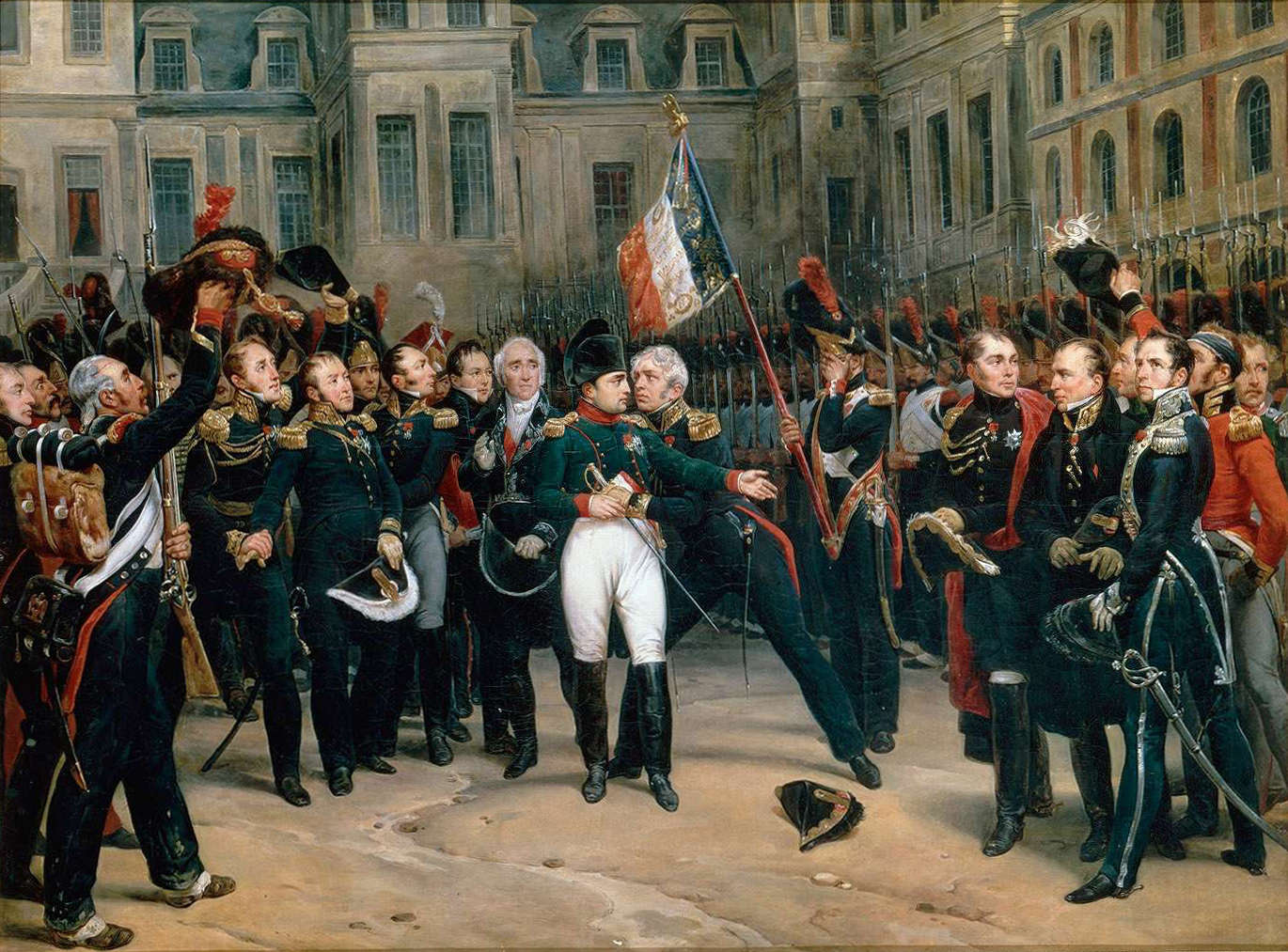
In 1813, however, the tide of the war turned. Napoleon was on the run, and the blockade was lifted. Cane sugar once again became readily available, and beet sugar was no longer competitively priced. All of the beet processing factories that had been built in Germany and Austria (part of Napoleon’s territory) were closed down. The following spring the Sixth Coalition defeated the French empire, and Napoleon—champion of the sugar beet—was exiled to the island of Elba.

Napoleon's Farewell to the Imperial Guard by Antoine Alphonse Montfort
Napoleon’s Farewell to the Imperial Guard by Antoine Alphonse Montfort

Then why do we eat beet sugar today?

France never quite gave up on sugar beet refinement. Between 1820 and 1839, the number of factories began to slowly climb again in response to a duty imposed on imported cane sugar. Once again, beet sugar was a cheaper alternative. The production of cane sugar also had an ugly stigma attached—it was only possible on large plantations using slave labor. Sugar beets could be grown and processed right at home, in factories that employed paid workers.

The process of refining sugar beets later became popular in Germany, the UK, Russia, and even spread across the Atlantic to the US. My home state of Michigan is one of eleven states that continue to produce beet sugar today, though the European Union is the world’s largest producer with about 50% of the total. Overall, beet sugar accounts for about 35% of the world’s production.

Beet sugar: just one example of the silver lining on a very dark cloud.

summer-banquet-hop-copy

Another silver lining of the Napoleonic Wars? Wounded warrior romance heroes! To celebrate the Summer Banquet Blog Hop, I’m giving away one of my very favorites: a signed, print copy of Grace Burrowes’ The Soliderdirect from the author herself!

Leave a comment below to enter: tell me what you learned today, what you really think of Napoleon, who your favorite historical soldier/sailor is, what draws you to this period of history, your obsession with sweets (or wounded warriors!), or whatever else you’d like.

Comments must be left by midnight EDT on June 7, 2013 to be eligible to win. Open worldwide.

Don’t forget to check out the posts and giveaways of all the Hop participants:

  1. Random Bits of Fascination (Maria Grace)
  2. Pillings Writing Corner (David Pilling)
  3. Anna Belfrage
  4. Debra Brown
  5. Lauren Gilbert
  6. Gillian Bagwell
  7. Julie K. Rose
  8. Donna Russo Morin
  9. Regina Jeffers
  10. Shauna Roberts
  11. Tinney S. Heath
  12. Grace Elliot
  13. Diane Scott Lewis
  14. Susan Mason-Milks
  15. Ginger Myrick
  16. Helen Hollick
  17. Heather Domin
  18. Margaret Skea
  19. Yves Fey
  20. JL Oakley
  21. Shannon Winslow
  22. Evangeline Holland
  23. Cora Lee (you are here)
  24. Laura Purcell
  25. P. O. Dixon
  26. E.M. Powell
  27. Sharon Lathan
  28. Sally Smith O’Rourke
  29. Allison Bruning
  30. Violet Bedford
  31. Sue Millard

Sources:

Agribusiness Handbook: Sugar Beets. Food and Agricultural Organization, United Nations. 2009

Agriculture and Rural Development. European Commission. 2013.

Bonaparte, Napoleon. The Berlin Decree. November 21, 1806.

Draycott, A. Philip (editor). Sugar Beet (World Agricultural Series). John Wiley & Sons, 2008.

Harveson, Robert M. “History of Sugarbeet Production and Use.” Crop Watch: Sugarbeets, University of Nebraska-Lincoln. Retrieved electronically May 2013.

Friday Favorites, Regency

Friday Favorite: Horrible Histories

My favorite historical item of the week comes from the BBC–a show that teaches history even as it mocks and makes fun (anybody else see the one with the singing King Georges?) :-). Time periods range from the Ancient Romans all the way up to World War II. You can visit the official website and watch clips form past episodes, or browse dozens and dozens of videos on YouTube.

http://www.bbc.co.uk/cbbc/shows/horrible-histories

Here’s a little taste:

Uncategorized

Whole Lotta Love: England as a Popular Setting in Historical Romance

I was reading the reviews on Amazon a couple of months ago for some Regency-era novel, and one reviewer was upset because the book was set in England (not the UK—she specifically mentioned England, so Scotland, Ireland, Wales, and the rest of the old Empire were apparently exempted).  She went on to comment that so many historical romances were set in England these days that she was sick of them all, and wondered why authors never used more exotic locales.

My first reaction was indignation—how dare she disparage a place and period so near and dear to my heart?!  And it was a Regency novel she was reviewng, what did she expect?  But the question rolled around in my head for a while, and I began to wonder the same thing, minus the resentment.  Why is England so popular a setting for historical fiction authors?

My attraction to English history is partly personal.  I adore reading about many locations and periods of time, but many of my ancestors are English, including my grandfather.  It’s interesting to me to study the history of a country so closely tied to my family.  And since said grandfather died before I was born, it’s also a way for me to connect with him, to get to know him through the culture and events of his first home.

I think, too, that Samantha Brown (from The Travel Channel) hit the nail on the head when she said that visiting England was, at least for Americans, Europe-light.  It is exotic for us with the differences in food, accents, and dialects, but it’s not way outside our comfort zones.  Traveling to London from the US seems kind of like visiting, say, Atlanta when you’re from Minneapolis—go with me on this one.  Some accents are hard to manage, sure, but they still speak English and you can make yourself understood.  Some of the food is decidedly different from what you’d find on your table at home, but it’s recognizable and you can find something you like.  Your trip is full of new and exciting experiences, and you don’t have to worry about whether or not you can read the street signs.

So what do you think?  Are there other reasons readers might favor stories set in England?  Or are there locations you prefer when you’re choosing a book?

Marriage

You Bastard! Illegitimacy During the Regency

Because I had to rein myself in last week replying to Barbara’s comment, and because I can use one of my favorite characters as an example (see if you can guess which one it is), this week’s blog post is about legitimacy (or the lack thereof).

In order to be considered a legitimate child during the Regency, your parents had to be married at the time of your birth.  It didn’t matter what their status was at your conception, as long as they made it to the altar—together—before you made an appearance in the world.  If you came before the nuptial ceremony, you were illegitimate, forever, even if your parents married later*.

If your mother was married to another man at the time of your birth, you were legitimate, but legally the child of her husband.  There are all kinds of subtle (and sometimes not so subtle) jokes and references in Regency and Georgian novels about ladies letting a “cookoo” in the nest—passing off the child of an affair as one belonging to her husband.  It’s even a major plot point in Julia Quinn’s It’s In His Kiss: the hero and his “father” both know he’s the product of his mother’s affair, but he’s still the legal heir to his “father’s” title and fortune.

Illegitimate offspring could not inherit titles or entailed property (property that, by law, passed to the next legitimate male heir).  Ever.  They could inherit unentailed property (property that could be disposed of in any manner), money, or goods by will—as could anybody else.

A great example of this is Mary Balogh’s A Secret AffairThe hero, Constantine Huxtable, was born two days before his parent’s wedding, thus rendering him ineligible to inherit his father’s earldom (this is actually the basis for the series, as a cousin inherits instead).  But wait, you say.  Grace Burrowes has a hero who’s illegitimate, and he’s an earl!  In The Soldier, Devlin St. Just is the bastard son of a duke, and he does gain an earldom, but not through inheritance. St. Just’s title was granted for service to the Crown during the Napoleonic Wars, and it was the monarch’s prerogative to confer the honor.  (Where do you think all those nobles came from in the first place?)

Bastardy was also a bar to society, for the most part.  According to Allison Lane, an illegitimate daughter was not accepted or welcome at all socially, while a son could be admitted to the fringes of society with the help and sponsorship of his father.  The heroine of Julia Quinn’s An Offer from a Gentleman is a good illustration: she was the bastard daughter of an earl, but never acknowledged as anything other than the earl’s ward, nor did she move in society (except once, but I won’t spoil it for you).

There were exceptions to this rule (there always are, right?), and a big one was William, Duke of Clarence (later William IV) had ten (yes, ten!) illegitimate children with an actress known as Mrs. Jordan.  Being the bastard get of a royal duke was clearly a better lot than that of other illegitimate children (and many legitimate ones, too).  Since their father was the son and brother of a king (then later a king himself), the FitzClarences, as they were called, did well socially.  They were given the precedence of the children of a marquess, the eldest son was granted an earldom, and the rest married nobles or the children of nobles.

*For those of you that are familiar with the medieval period, you’re probably jumping up and down right now, yelling “John of Gaunt!” or “Beaufort!” (or maybe you’re yelling something else at me!).  Yes, John of Gaunt (son of Edward III) had four children with his mistress Katherine Swynford and given the surname Beaufort (after one of John’s properties).  And yes, they were eventually legitimized by the pope and their cousin Richard II when John scandalized everyone and married Katherine (their children were adults by then).  But this was under the medieval Catholic Church, where rules could be bent for the right price, and John was a very powerful man.  And this legitimacy was questioned a couple of generations later when Henry Tudor, great-great-grandson of John through his eldest Beaufort son, claimed the English throne.  The Regency was several hundred years after the Reformation, andBritain’s aristocracy was (for the most part) steadfastly Protestant.  Different time, different church, different rules.

Marriage

Annulments: 99 Problems, But A Wife Ain’t One

After reading Regina Jeffer’s blog post about the rules of marriage in Regency England last week, I started thinking about ways to dissolve a marriage (I know, ever the optimist, aren’t I?) during the period.

Marriages of convenience show up in romance novels of all types, usually with the understanding that the couple can part ways after their union is no longer useful.  In Regency romances, I’ve seen a lot of marriages dictated by a will (as in “you must marry by a certain age/time frame or you will lose your inheritance”), and marriage to one person to escape marrying another (often a “my father wants me to marry this horrible, old man, and I don’t want to” sort of thing, though sometimes it’s a prospective groom who is being hounded to marry a woman of his family’s choosing).  They always say, “We can get an annulment later.”

Of course, they don’t–they fall in love and decide to stay married.  But while they’re falling in love, the newly wed couple is usually trying to preserve a situation where an annulment could be granted.  And while annulments are certainly possible during the Regency, they were only obtainable under certain circumstances.

–>Fraud: a participant in the wedding used a fake name or anything short of his/her full legal name (including all titles) OR a promise was made in the marriage contract that cannot be kept.  Though, in the case of a misused name—say a nobleman forgot to include one of his multitude of titles on the register—the presiding authority can decline to issue the annulment and simply correct the register.

–> Incompetence: a participant in the wedding was under 21 (a legal minor) and did not have consent of his/her legal guardian (your father, if he was still alive) OR insanity (which tainted the entire family–if one of you is insane, what about the rest?)

–>Impotence: the physical incapability of a man to have intercourse, not the abstinence from it.  Doctors became involved, and, according to Allison Lane, the use of very skilled courtesans!  (Mary Jo Putney’s The Bargain—previously title The Would-Be Widow—does a pretty good job with this, and though her method does not match what Allison has described, it’s a logical process…minus the courtesans 😉

Divorce was even more difficult, a long process that involved civil courts, ecclesiastical courts, and the House of Lords.  It was very messy, very public, and very expensive.  A divorced man’s reputation was basically trashed, though he might be able to find some acceptance somewhere (the hero of Laura Lee Guhrke’s And Then He Kissed Her—the inspiration for the name of this blog [though I haven’t finished the book yet!]—is divorced at the start of the story).  A divorced woman was pretty much cast out of society, ruined beyond repair.

For more details and examples, check out Allison Lane’s Common Regency Errors page.  She has some great information on inheritance of properties and titles, and a wonderful section about forms of address for titled nobles and their families.