New Posts

Friday Favorites

Friday Favorite: The 1812 Overture

Officially titled The Year 1812 Festival Overture in E-flat major, Op. 49, the 1812 Overture was composed by Pyotr Ilyich Tchaikovsky in 1880. Tsar Aleksander I had commissioned a church to be built commemorating Russia’s victory over Napoleon in 1812, and the church was nearing completion. Big festivities were planned, but derailed when Tsar Aleksander II was assassinated in March 1882. (The piece was eventually performed, but indoors with a conventional orchestra.)

Written for outdoor performance with pealing bells and live cannon fire, the Overture is a musical war between la Marseillaise (representing Napoleon’s French army) and God Save the Tsar (representing the Russian Empire). The French national anthem is strong in the beginning, but is beaten back as the piece moves, drown out by the cathedral bells, cannon, and the Russian national anthem. (Interestingly enough, neither anthem was in use at the time of the actual battle.)

Have a listen and see if you can pick them out:

Here’s the entire Overture for the musically adventurous among you:

Here in the US, we use the 1812 Overture to celebrate our own Independence Day, which seems strange given the original purpose of the music. This article in the Pittsburgh Post-Gazette posits a theory as to why.

Regency

Eyeglasses of the Regency

Written by Jacqueline Diamond, whose half-dozen traditional Regency romances, now available as ebooks, include Rita Award finalist THE FORGETFUL LADY as well as LADY IN DISGUISE and A LADY OF LETTERS. Published in the Regency Reader, July 2013.

Since people suffered from visual defects in earlier centuries just as they do now, it should be no surprise that, throughout the ages, inventors, artisans, jewelers and glassmakers put their talents to use improving our ability to see.

The earliest known use of lenses to aid vision was in ancient Egypt and Assyria, where people were depicted using magnifying stones such as polished crystals. In the first decade B.C., Roman philosopher Seneca used water-filled objects to magnify text for reading.

Reading Stone via http://thestoryofmocroscope.blogspot.hu/

Around the year 1000 A.D., Muslim scholar Alhazen (965-1040)-known as the father of modern optics-wrote a seven-volume treatise on the subject. In the late 12th century, Marco Polo claimed that eyeglasses were popular among the wealthy Chinese. The demand for spectacles grew dramatically by the end of the 15th century, thanks to the invention of the printing press and the much wider availability of reading material.

Here are some good sites about ancient glasses:
http://optical.com/eyeglasses/history-of-eyeglasses/
http://www.antiquespectacles.com/history/ages/through_the_ages.htm
http://io9.com/strange-and-wonderful-moments-in-the-history-of-eyeglas-507302709

My own myopia inspired me, for my sixth traditional Regency romance, to create a nearsighted heroine. In A Lady’s Point of View, Meg Linley–forbidden by her mother to wear eyeglasses–accidentally causes a scandal by cutting Beau Brummell at a ball. Then, sent home in disgrace, she gets into the wrong carriage and is mistaken for a governess.

In 1989, when Harlequin published the novel, I had to dig through books for a few snippets of information on eyeglasses during the Regency. Imagine my delight, when preparing the recent ebook release, at finding a treasure trove of information on the Internet.

Here’s a look at the situation that would have affected my heroine:
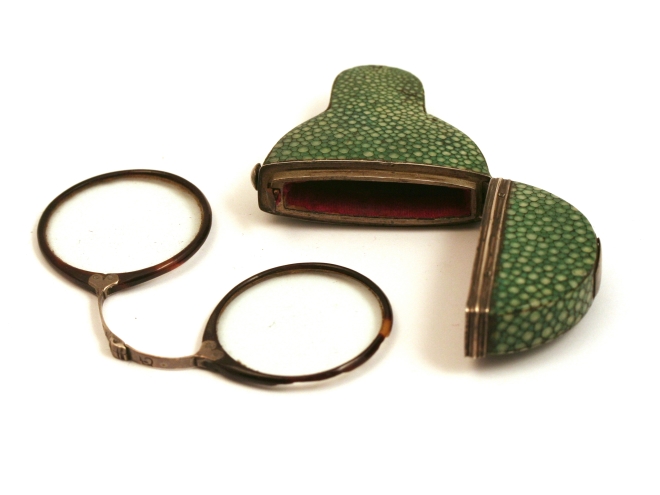
An English optician, Edward Scarlett (1677-1743), is credited with developing eyeglasses that rest on the nose and ears. While the exact origin of bifocals is debated, Benjamin Franklin usually gets the credit. Bifocals were found in London after the 1760s.

Spectacles with tortoise shell and silver rims and a shagreen case, c. 1770 via http://susanewington.blogspot.hu/2012_05_01_archive.html

However, glasses weren’t considered fashionable by the Regency upper crust. Instead, the Beau Monde preferred the quizzing glass, a magnifying lens with a handle that the user peered through.

Quizzing glasses remained popular until the 1830s, when the lorgnette gained in popularity, especially among women. First appearing between 1795 and 1805, the lorgnette is a pair of lenses with a short handle. Also known as opera glasses, these derived their name from the French word lorgner, to ogle.

The quizzing glass was usually set with a magnifying lens, although in some cases a corrective lens was used. Goldsmiths or jewelers provided the frames, often made of gold or sterling silver, with elaborate designs. These hung from a chain attached to the handle-of varying lengths-or loop.

For charming pictures of eyewear from the Regency, I recommend these sites:
http://historicalhussies.blogspot.com/2010/08/regency-glasses-and-eyeware.html
http://candicehern.com/collections/04/eyeglass.htm

Books, Friday Favorites

Friday Favorite: Slightly Dangerous

Description (from Amazon):

“All of London is abuzz over the imminent arrival of Wulfric Bedwyn, the reclusive, cold-as-ice Duke of Bewcastle, at the most glittering social event of the season. Some whisper of a tragic love affair. Others say he is so aloof and passionless that not even the greatest beauty could capture his attention. But on this dazzling afternoon, one woman did catch the duke’s eye—and she was the only female in the room who wasn’t even trying. Christine Derrick is intrigued by the handsome duke…all the more so when he invites her to become his mistress.

What red-blooded woman wouldn’t enjoy a tumble in the bedsheets with a consummate lover—with no strings and no questions asked. An infuriating lady with very definite views on men, morals, and marriage, Christine confounds Wulfric at every turn. Yet even as the lone wolf of the Bedwyn clan vows to seduce her any way he can, something strange and wonderful is happening. Now for a man who thought he’d never lose his heart, nothing less than love will do.”

This is one of my favorite books of all time! Like The Madness of Lord Ian Mackenzie, Slightly Dangerous at first appears to be like any other Regency romance. The beauty in this story, though, is its leading man, Wulfric Bedwyn. He is every inch the cold, formidable duke in public (and sometimes with his siblings). But throughout the previous five books, the reader gets tiny peeks at the man under all that ice. You see his loneliness and isolation, the way he adores his family even when he can’t (or won’t) tell them. You discover little pieces of his soul.

I fell in love. And then, so did he 🙂

http://www.amazon.com/Slightly-Dangerous-Balogh-Mary-ebook/dp/B000FC1PBG/ref=tmm_kin_title_0?ie=UTF8&qid=1371758779&sr=8-1

Slightly Dangerous

Fashion

Regency Fashion: Men’s Breeches, Pantaloons, and Trousers

Vic's avatarJane Austen's World

One of the benefits of gathering images for Pinterest is that one’s awareness of the minute differences in fashions from year to year improves. Daily exposure to thousands of fashion images from the Georgian era have taught me to notice the nuances of style and line. These images are one-sided, since very few articles of clothing from the lower classes survive. With rare exceptions, most museum quality fashions were made for the wealthy, and one must keep in mind when studying these images that fashions for the upper classes were vastly different from those of the working poor or laboring classes. Men’s trousers are a perfect example of class distinction.

By the turn of the 19th century, breeches, pantaloons and trousers worn by all men were sewn with a flap in front called a fall front. This flap was universally held in place by two or three buttons at the…

View original post 677 more words

Books, Friday Favorites

Friday Favorite: Richard Armitage Reads Georgette Heyer

Hold on to your e-readers and mp3 players, ladies! Our Friday Favorite this week is Richard Armitage. He’s best known for his portrayal of John Thornton in North and South, Lucas North in MI-5 (Spooks across the Atlantic), and most recently as Thorin Oakenshield in The Hobbit movies.

Richard Armitage

But in the last few years he’s also gotten into audiobook narration, including three of Georgette Heyer’s novels: The Convenient Marriage, Venetia, and Sylvester.

Audio clips:

Interview for The Convenient Marriage, where Richard talks about the difference between doing audiobooks and screen acting, and his love of music. (June 2010)

Interview for Venetia, where he talks about how he got started with audiobooks, and his reading habits. (March 2010)

Excerpt from Georgette Heyer’s Venetia, complete with separate voices for each character.

You can find these clips and other audio at Richard Armitage Central. But make sure you come up for air once in a while 😉