Our Friday Favorite this week is what I like to call “modern music for historical romance”. It’s the story of Jane Austen’s Emma and her Mr. Knightly, set to the music of Taylor Swift’s Love Story. That might sound like an incongruous pairing, but it totally works. Take a look!
For more period drama set to modern music, check out my Pinterest board on the subject.
Do you have Christmas money burning a hole in your pocket? Gift certificates to spend? Want to get the biggest bang for your buck? Try these online sources for free and/or cheap e-books. (Note: I’m not affiliated in any way with any of the websites or with Amazon–I just happen to own a Kindle, so these are the sites that I check.)
Discounted/Price Dropped Kindle Books thread A thread on the Amazon message boards where people post price drops for e-books, mostly for US readers (though there are regular posts from Aussie and French Kindlers, too). No indie/self-published books. All genres. Occasionally Barnes & Nobel sales are mentioned here, too, since Amazon price-matches, so Nook readers may find this useful.
Free Today Second Edition thread Another thread on the Amazon message boards, this one dedicated specifically to free romance e-books for US readers. The prices on these often change quickly, so start with the newest post.
Daily Cheap Reads I did a post on this website back in August, but it doesn’t hurt to mention it again. This site is dedicated to books, apps, and audiobooks for under $5 in the US. There is a companion site for UK readers, and one focused on cheap reads for children and young adults.
eReaderIQ A website dedicated to freebies, price drops, e-books under $1, and newly kindle-ized books. You can visit the site and look around on your own, or set up notification for books or authors and let the site do the work for you. Books published in all varieties are included, from all genres. US readers only.
Goodreads Bargain Basement Group Freebies, bargains, and giveaways for Nook, Kindle, and Smashwords. Includes all genres, seems to be US only.
This week’s Friday Favorite comes courtesy of Arika Okrent at Mental Floss, one of my favorite websites. Old words tend to hang around in our lovely language, sometimes only for the sake of certain expressions.
Photo Credit: Antonio Litterio
English has changed a lot in the last several hundred years, and there are many words once used that we would no longer recognize today. For whatever reason, we started pronouncing them differently, or stopped using them entirely, and they became obsolete. There are some old words, however, that are nearly obsolete, but we still recognize because they were lucky enough to get stuck in set phrases that have lasted across the centuries. Here are 12 lucky words that survived by getting fossilized in idioms.
1. WEND
You rarely see a “wend” without a “way.” You can wend your way through a crowd or down a hill, but no one wends to bed or to school. However, there was a time when English speakers would wend to all kinds of places. “Wend” was just another word for “go” in Old English. The past tense of “wend” was “went” and the past tense of “go” was “gaed.” People used both until the 15th century, when “go” became the preferred verb, except in the past tense where “went” hung on, leaving us with an outrageously irregular verb.
2. DESERTS
The “desert” from the phrase “just deserts” is not the dry and sandy kind, nor the sweet post-dinner kind. It comes from an Old French word for “deserve,” and it was used in English from the 13th century to mean “that which is deserved.” When you get your just deserts, you get your due. In some cases, that may mean you also get dessert, a word that comes from a later French borrowing.
3. EKE
If we see “eke” at all these days, it’s when we “eke out” a living, but it comes from an old verb meaning to add, supplement, or grow. It’s the same word that gave us “eke-name” for “additional name,” which later, through misanalysis of “an eke-name” became “nickname.”
4. SLEIGHT
“Sleight of hand” is one tricky phrase. “Sleight” is often miswritten as “slight” and for good reason. Not only does the expression convey an image of light, nimble fingers, which fits well with the smallness implied by “slight,” but an alternate expression for the concept is “legerdemain,” from the French léger de main,” literally, “light of hand.” “Sleight” comes from a different source, a Middle English word meaning “cunning” or “trickery.” It’s a wily little word that lives up to its name.
5. DINT
“Dint” comes from the oldest of Old English where it originally referred to a blow struck with a sword or other weapon. It came to stand for the whole idea of subduing by force, and is now fossilized in our expression “by dint of X” where X can stand for your charisma, hard work, smarts, or anything you can use to accomplish something else.
6. ROUGHSHOD
Nowadays we see this word in the expression “to run/ride roughshod” over somebody or something, meaning to tyrannize or treat harshly. It came about as a way to describe the 17th century version of snow tires. A “rough-shod” horse had its shoes attached with protruding nail heads in order to get a better grip on slippery roads. It was great for keeping the horse on its feet, but not so great for anyone the horse might step on.
7. FRO
The “fro” in “to and fro” is a fossilized remnant of a Northern English or Scottish way of pronouncing “from.” It was also part of other expressions that didn’t stick around, like “fro and till,” “to do fro” (to remove), and “of or fro” (for or against).
8. HUE
The “hue” of “hue and cry,” the expression for the noisy clamor of a crowd, is not the same “hue” as the term we use for color. The color one comes from the Old English word híew, for “appearance.” This hue comes from the Old French hu or heu, which was basically an onomatopoeia, like “hoot.”
9. KITH
The “kith” part of “kith and kin” came from an Old English word referring to knowledge or acquaintance. It also stood for native land or country, the place you were most familiar with. The expression “kith and kin” originally meant your country and your family, but later came to have the wider sense of friends and family.
10. LURCH
When you leave someone “in the lurch,” you leave them in a jam, in a difficult position. But while getting left in the lurch may leave you staggering around and feeling off-balance, the “lurch” in this expression has a different origin than the staggery one. The balance-related lurch comes from nautical vocabulary, while the lurch you get left in comes from an old French backgammon-style game called lourche. Lurch became a general term for the situation of beating your opponent by a huge score. By extension it came to stand for the state of getting the better of someone or cheating them.
11. UMBRAGE
“Umbrage” comes from the Old French ombrage (shade, shadow), and it was once used to talk about actual shade from the sun. It took on various figurative meanings having to do with doubt and suspicion or the giving and taking of offense. To give umbrage was to offend someone, to “throw shade.” However, these days when we see the term “umbrage” at all, it is more likely to be because someone is taking, rather than giving it.
12. SHRIFT
We might not know what a shrift is anymore, but we know we don’t want to get a short one. “Shrift” was a word for a confession, something it seems we might want to keep short, or a penance imposed by a priest, something we would definitely want to keep short. But the phrase “short shrift” came from the practice of allowing a little time for the condemned to make a confession before being executed. So in that context, shorter was not better.
One of the reasons I adore Doctor Who so much is the show’s penchant for visiting Victorian London. So, to celebrate Christmas, history, and Matt Smith’s last episode as The Doctor, I present you with a bit of time-traveling eye candy.
Our Friday Favorite this week once again combines two of my favorite things: the Library of Congress’s Jefferson Building and Christmas trees. Workers last week put up a large tree in the Great Hall, as they do every year. If you click on the picture, you’ll open a larger image–check out the detail in those arches and the crown molding!
Ready to gear up for the holidays with some Christmas romance novels? This week’s Friday Favorite comes from Katherine Ashe:
“I adore Christmas romances. From Regency lords and ladies on romantic sleigh rides to crazy church Pageants in contemporary small towns, I can’t get enough of holiday love stories. After all, love is the meaning of Christmas.
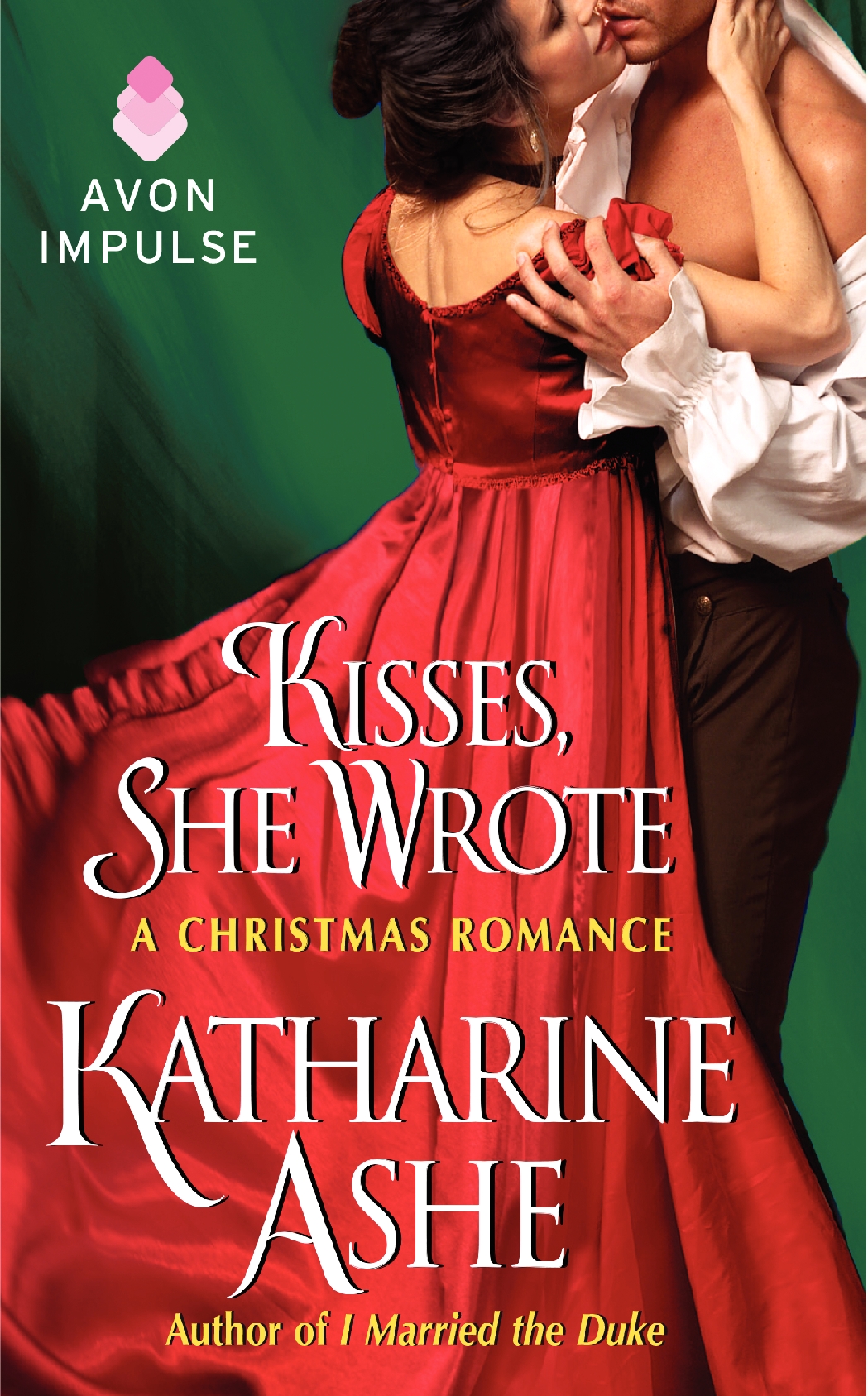
“My Christmas novella, Kisses, She Wrote, is finally here! (99¢ ebook & $3.99 paperback). But for weeks already I’ve been in the mood for delicious holiday reads to satisfy that cozy craving for romance. So I’m compiling a list of new and re-released Christmas romances,* including full-length novels, anthologies, novellas and short stories. I hope you’ll find stories here to enjoy curled up by the fire with a cup of hot cocoa or mulled wine, a plate of cookies beside you, and maybe even your best furry friend warming your toes.
Wishing you a very Merry Christmas!
~ Katharine”
Click here to see the list, including stories by Shana Galen, Barbara Monajem, Jennifer Ashely, Robin Carr, Elizabeth Essex, and my critique partner Susana Ellis!
This week’s Favorite is a culinary treat, courtesy of Sasha Cottman. Born in England, but having lived most of her life in Australia, Sasha feels fortunate to have family on both sides of the world. Her love for Regency Romance derives from a lifelong passion for history and a mistaken enrollment in a romance writing course. You can follow Sasha and find out more about her and her books on her website: http://www.sashacottman.com
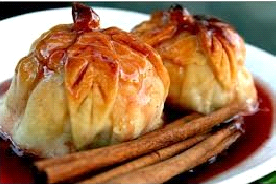
Apple Dumplings
by Sasha Cottman
This recipe for apple dumplings comes from The Experienced English House- keeper, 1789.
Ingredients
For making the pastry you can either use these ingredients or buy pastry sheets.
8 oz (250g) flour, 1 egg yolk, 4 oz (125g) butter, or butter and lard, A pinch of salt.
4 good eating apples. Cream, or custard to serve. We used vanilla custard.
4 tsp marmalade, or sultanas, or jam or sugar and cinnamon. We used sultanas and cinnamon in one dumpling and blackberry conserve in the others. You could use any sort of sweet filing.
Method
Preheat the oven to 400F/200C/Gas Mark 6.
Make the pastry or get the frozen pastry sheets out of the freezer. Divide the pastry into 4 equal portions and roll them out thin. This is why I used pastry sheets.
Peel and core the apples. If you don’t have an apple corer, you could cut the apple in half, cut out the seeds, etc. and then put the apple together again when you wrap the pastry around it. I did try to core the first apple with a sharp knife but made such a mess that only 3 apples made it into the oven.
Lay each apple on the pastry, allowing the pastry to come up a little more than halfway up the apple.
Put the filing inside the apple. Cut a small square of pastry to go over the top. I smoothed the pastry joins, etc. with a little warm water and clean fingers. The leaves and worm were an added decoration.
Spray an oven tray with some baking spray and a little on the top of the pastry to help it brown.
The Friday Favorite is back! And this week, we celebrate history, mystery, and Doctor Who all in one go.
Author Philip Pullman calls his four Sally Lockhart mystery novels “old-fashioned Victorian blood-and-thunder”. BBC liked them enough to make the first two into TV movies. PBS picked them up in the US as part of their Masterpiece Mystery series (staring Billie Piper as the title character, and Matt Smith as one of her trusted friends).
Information about the books from the author’s website.
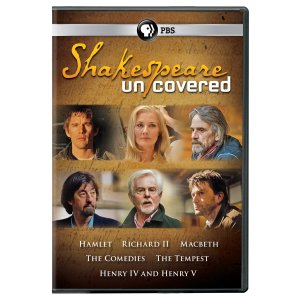
Shakespeare’s plays and sonnets were a hot topic during the Regency. Love them or hate them, most educated people had read them (or pretended to). But in this day and age, Shakespeare is something crammed down our throats in school, something we endure like a bad dentist appointment. Wouldn’t it be nice instead to parse out a play, have it make sense, and enjoy the process?
Now you can!
PBS produced a six-part series called Shakespeare Uncovered earlier this year. Each episode follows a renowned actor as s/he researches one of The Bard’s plays (or pair of connected plays), consulting historians, Shakespearean scholars, and other actors in an effort to find the meaning and the heart inside the story.
As much as I can appreciate the talent Shakespeare clearly possessed, I’ve never been a fan. But watching this series helped me to look at his works from a historical and a literary point of view, helped me to get past the fudging of facts and mind-numbing word games. I really enjoyed the whole series, and I learned a lot too!
You can catch the whole series on Netflix or on PBS’s website.
Every author has her favorite resources, and this week I’m sharing one of mine.
As the title suggests, it’s a book of fashion plates from the years 1800-1819. Descriptions are only occasionally provided, but the source of each plate is always identified (magazines such as Ladies’ Monthly Museum, Costume Parisien, La Belle Assemblee, and Ackermann’s Repository) along with the year of publication.
Since I’m a huge visual learner, the plates themselves are more important to me than the descriptions. With this book I can see what dinner dresses and pelisses and poke bonnets looked like, what colors they might have been, and how a lady might have worn them. 🙂





 Cora Lee, Regency Romance Author