Cora Lee is a National Bestselling author of Regency romance. She went on a twelve year expedition through the blackboard jungle as a high school math teacher before publishing Save the Last Dance for Me, the first book in the Maitland Maidens series. She then followed it up with six other novels and novellas ranging from sweet and traditional to spicy and suspenseful.
When she’s not walking Rotten Row at the fashionable hour or attending the entertainments of the Season, you might find her participating in Regency Fiction Writers events, wading through her towering TBR pile, or eagerly awaiting the next Marvel movie release. If you’d like to find out more about Cora or her books you can sign up for her newsletter, or connect with her on Facebook, BlueSky, Bookbub, or Goodreads.
Roof Beam Reader is hosting the 2nd annual Austen in August event, a celebration of all things Jane Austen. Participants read as many Austen or Austen-related works as they choose (biographies, spin-offs, contemporary re-imaginings, and re-reads count too!), and blog about their adventures. Roof Beam Reader will also be hosting guest posts and giveaways throughout the month.
If you’d like to be a part of Austen in August, you can sign up or find more info here. Some of the giveaways require that you sign up by August 3rd, but others don’t. You can participate in the reading and blogging at any time.
Any posts you make for Austen in August should be linked here.
I’m signed up and ready to go–my Kindle is full, my audible account is stocked. Who’s joining me?
“A riddle or pun on a man’s name, expressed in sculpture or painting, thus: a bolt or arrow, and a tun, for Bolton; death’s head, and a ton, for Morton.”
The winner of my giveaway–the 6-pack of credits at Discover a New Love–is Mel (bournmelissa at hotmail dot com)!
The grand prize winner, with the most correct scavenger hunt answers, is Jessica (jessica dot deluna at gmail dot com)! She won a $50 gift certificate to her favorite book retailer.
Congratulations to both of you, and happy shopping!
Here’s how the hop works: each author invites up to five other authors to answer five questions about their current summer release or WIP, and to share a tasty recipe that ties into it. The list of participating authors can be found at the end of this post. As more authors join the hop, I will post links to their blogs so you can add these awesome treats (and reads) to your list.
My current work-in-progress is a two-fer: All You Wanted and The Only Exception. The Only Exception is the story of Miss Katherine Sedgley and John, Earl of Wrexham:
She knows his secrets… Wealthy and powerful, the Earl of Wrexham commands the respect of the ton—but not the woman who knows his hidden vulnerabilities. He cut Kate out of his life years ago, but her sudden return to Town threatens his reputation and everything he’s become. Will she ruin his carefully crafted image and his family’s good name?
photo credit: paramore.net
Will she destroy his chance to find a suitable bride? What is he willing to do to secure her silence…and his future?
He knows her heart… Bluestocking Kate Sedgley fled to the country after her third disastrous Season, and hasn’t returned to Town since—until her uncle cuts her purse strings. With no talent or trade, Kate knows the only way to support herself is to marry. But who wants a disgraced spinster with no dowry and a frail, helpless mother? Lord Wrexham came to her rescue once, long ago. Can she convince him to do so again? How far will she go to ensure his help…and her security?
All You Wanted is a prequel novella that details Wrexham’s backstory with Kate, how they first met, what their relationship was like initially, and why it didn’t work out at the time. It also lets you in on one of his secrets 😉
Now for the Random Tasty Questions:
1) When writing are you a snacker? If so sweet or salty?
I don’t eat while I write–I always want to get the ideas from my head into their Word file before I forget the details, and I can’t type fast enough with just one hand. But when I’m revising, editing, or just re-reading, I will snack. For me that usually involves something sweet: iced animal crackers, dry cereal, any of the sweet Chex mixes, etc. In the summer fruit is easier to find, so I’ll end up with a bowl of sweet black cherries or a nice big apple, too.
2) Are you an outliner or someone who writes by the seat of their pants? And are they real pants or jammies?
With small pieces (like blog posts) I can just go with the flow. But anything that has more than one chapter gets an outline. First, an outline helps me to actually see the whole story. Second, it preserves whatever thoughts and ideas I’m having while I make the outline. It may change–sometimes drastically–later, but I don’t have to worry about forgetting where I was going with a certain piece of dialog.
3) When cooking, do you follow a recipe or do you wing it?
photo credit: joyfulbelly.com
When I cook meals I stick to simple things (spaghetti, casseroles, burgers on the grill) that don’t really require recipes. When I bake things can get complicated. I like to use a recipe a few times and get a feel for it, then I’ll start making adjustments and additions. But chemistry is so important in baking that I don’t want to mess with the basic ingredients too much.
4) What is next for you after this book?
I have so many Regency plots floating around inside my head (and in my notebook), that I think I’ll be sticking around country estates and London drawing rooms for a while. Lord Wrexham’s brother Henry is the next hero on my horizon, a man who copes with OCD in a time when “madness” will get you locked up.
5) Last question…on a level of one being slightly naughty and ten being whoo hoo steamy, how would you rate your book?
When I started this story, I meant it to be kind of hot. But Miss Sedgley and his lordship have informed me otherwise, so it’s coming out somewhere just hotter than Georgette Heyer. I guess that makes it about a 3, maybe 🙂
And now for the really tasty part: Cherry Ratafia
If you’ve read Regency romance novels before, you’ve probably come across a scene involving ratafia. Ratafia is basically an infusion: fruit, vegetables, or herbs and spices are prepared and left to sit in in alcohol (usually wine, vodka, or brandy). It reminds me a little of sangria, which also involves fruit and alcohol but doesn’t require steeping.
Since Miss Sedgley and Lord Wrexham spend much of their time at social events, I thought ratafia would be the perfect accompaniment to their story. This particular recipe is a modern one that comes from the Abruzzo region of Italy, courtesy of Valerie Fortney-Schneider. Like sangria, there are dozens of recipes for ratafia, but this one seems the tastiest!
1 1/2 pounds pitted cherries
1 bottle Montepulciano d’Abruzzo
1 cup grain alcohol (or high-proof, good quality vodka)
1 stick of cinnamon
photo credit: bonappetit.com
1 vanilla bean
a big glass jar or bottle that will seal well
Split the vanilla bean open and put it in the jar, along with the other ingredients. Give it a shake and put it in a dark place for 40 days and 40 nights, shaking it gently every few days. After the maceration period, strain it.
Combine 1 cup of sugar and 1 cup of water in a saucepan, bring to a gentle boil, stirring well to dissolve the sugar, then turn off the heat and let it cool. Add it to the liqueur, stirring well. Divide into bottles and keep in a cool, dark place.
While you’re enjoying your cherry ratafia, visit the other authors of the Tasty Summer Reads Blog Hop:
This week’s Friday favorite is what I like to call modern music for historical romance. The song is described as rockabilly, but sounds a little more swing-ish and bluesy to me. Have a listen and judge for yourself.
The artist is Irish-born Imelda May, singing “Big Bad Handsome Man”. Remind you of any heroes you’ve read about lately? 😉
If you were a bookish sort of girl during the Regency period, where would you go on an outing with a gentleman? Assuming you found a gentleman who appreciated a lady with a sharp mind, and a chaperone willing to accompany you, you might make a trip to the British Museum.
An engraving of Montagu House (credit: British Museum)
In 1675 Ralph Montagu (later the 1st Duke of Montagu) bought a piece of property on what was then the northern outskirts of London, and built himself a grand house. When it burned down a few years later he built an even bigger one, more palace than house. Upon the 1st Duke’s death, his son inherited the property, but had no son to follow him. The 2nd Duke’s two daughters inherited the unentailed property when he died, including Montagu House in London. Since both were married with homes of their own neither sister actually lived in the place, and it began to fall into disrepair.
Enter the trustees of the newly-founded British Museum, who were looking for a building suitable for housing antiquities and other collections. They bought Montagu House in 1754 for 10,000 pounds and hired a Mr. Bramley as gardener. Within a year the lawns, gravel walks, and kitchen gardens were restored to their former glory. By 1757, the gardens were open to the public a full two years before the building itself was ready. By 1800, 600 different species of plants had been established on the grounds.
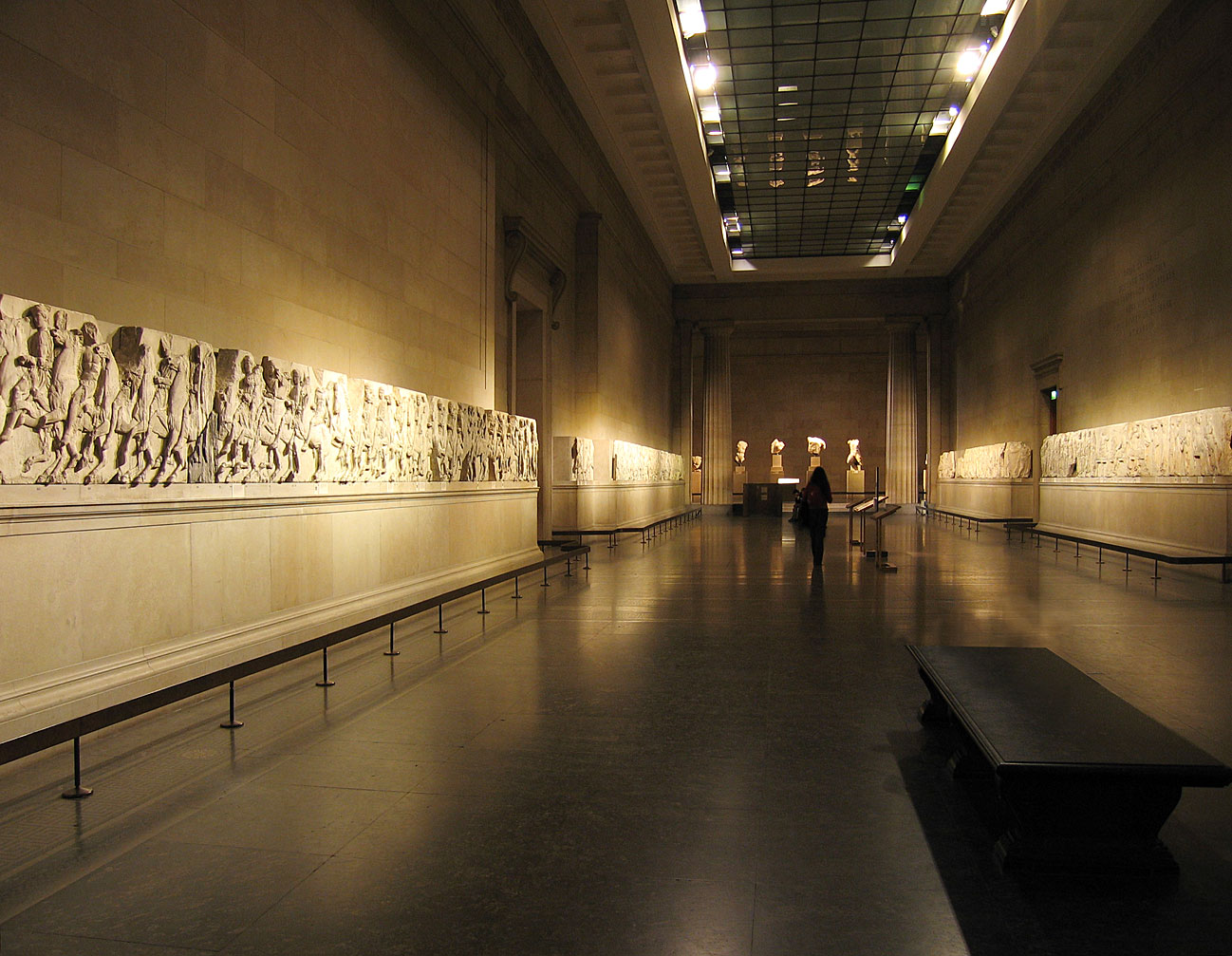
Part of a frieze taken from the Parthenon by Lord Elgin (credit: British Museum)
What would you have seen inside? A big attraction was the Parthenon Sculptures brought to England by Thomas Bruce, 7th Earl of Elgin (popularly known as the Elgin Marbles). On display since 1817, the sculptures were originally part of the Parthenon in Greece, decorating the building as it went from Athenian temple to Catholic church to Muslim mosque. When Lord Elgin took up his post as British Ambassador to the Ottoman Empire, the Parthenon was a ruin. As a way of preserving what was left, he removed statues and friezes from the Parthenon and sent them home to London. This jump-started a craze in England (and the rest of Europe) for all things Greek.
Have you read a Regency novel where a character dressed as a Greek goddess for a masquerade? Have you heard gowns or hairstyles described as Grecian? The Elgin marbles were a large part of this cultural phenomenon. And they are still on display at the British Museum to this day.
The Elgin Marbles collection today (credit: Wikipedia)
And now for the giveaways!
Leaving a comment on this post will enter you in my individual giveaway: a 6-pack of credits at Discover a New Love. Each e-book is 1 credit, and they often have books available before their public release. This giveaway is open to anyone in any country, but comments must be left by 11:59 pm EST on Friday, July 26, 2013 to be entered.
We’re also having a Hop-wide scavenger hunt! Just visit each of the websites participating in the Grand Tour, and enter your answers to their scavenger hunt questions here. The entrant with the most correct answers will receive a $50 gift certificate to the book retailer of her choice. This contest is also open internationally, and entries must be submitted by July 26, 2013.
Scavenger Hunt question: What year did the Elgin Marbles go on display at the British Museum?
Our Friday Favorite this week is a treasure trove of information. Regency romance author Candice Hern recently revamped her website, and now it’s bigger and better than ever!








 Cora Lee, Regency Romance Author