Cow-Hearted
“Fearful.”
“Fearful.”

If you were a bookish sort of girl during the Regency period, where would you go on an outing with a gentleman? Assuming you found a gentleman who appreciated a lady with a sharp mind, and a chaperone willing to accompany you, you might make a trip to the British Museum.

In 1675 Ralph Montagu (later the 1st Duke of Montagu) bought a piece of property on what was then the northern outskirts of London, and built himself a grand house. When it burned down a few years later he built an even bigger one, more palace than house. Upon the 1st Duke’s death, his son inherited the property, but had no son to follow him. The 2nd Duke’s two daughters inherited the unentailed property when he died, including Montagu House in London. Since both were married with homes of their own neither sister actually lived in the place, and it began to fall into disrepair.
Enter the trustees of the newly-founded British Museum, who were looking for a building suitable for housing antiquities and other collections. They bought Montagu House in 1754 for 10,000 pounds and hired a Mr. Bramley as gardener. Within a year the lawns, gravel walks, and kitchen gardens were restored to their former glory. By 1757, the gardens were open to the public a full two years before the building itself was ready. By 1800, 600 different species of plants had been established on the grounds.

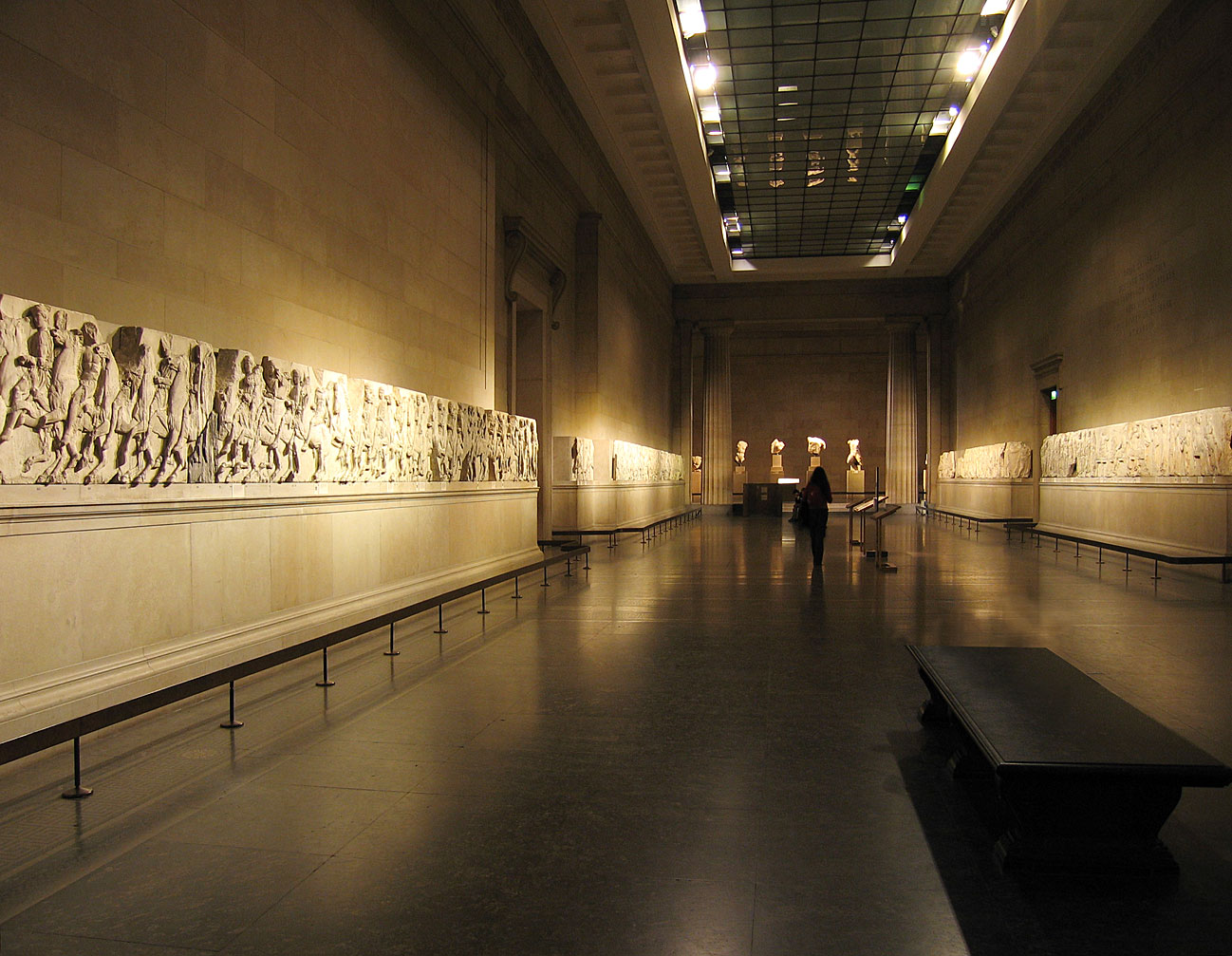
What would you have seen inside? A big attraction was the Parthenon Sculptures brought to England by Thomas Bruce, 7th Earl of Elgin (popularly known as the Elgin Marbles). On display since 1817, the sculptures were originally part of the Parthenon in Greece, decorating the building as it went from Athenian temple to Catholic church to Muslim mosque. When Lord Elgin took up his post as British Ambassador to the Ottoman Empire, the Parthenon was a ruin. As a way of preserving what was left, he removed statues and friezes from the Parthenon and sent them home to London. This jump-started a craze in England (and the rest of Europe) for all things Greek.
Have you read a Regency novel where a character dressed as a Greek goddess for a masquerade? Have you heard gowns or hairstyles described as Grecian? The Elgin marbles were a large part of this cultural phenomenon. And they are still on display at the British Museum to this day.
And now for the giveaways!
Leaving a comment on this post will enter you in my individual giveaway: a 6-pack of credits at Discover a New Love. Each e-book is 1 credit, and they often have books available before their public release. This giveaway is open to anyone in any country, but comments must be left by 11:59 pm EST on Friday, July 26, 2013 to be entered.
We’re also having a Hop-wide scavenger hunt! Just visit each of the websites participating in the Grand Tour, and enter your answers to their scavenger hunt questions here. The entrant with the most correct answers will receive a $50 gift certificate to the book retailer of her choice. This contest is also open internationally, and entries must be submitted by July 26, 2013.
Scavenger Hunt question: What year did the Elgin Marbles go on display at the British Museum?
History Lovers Grand Tour Authors:
Rue Allyn / Amylynn Bright / Collette Cameron / Téa Cooper / Beverley Eikli / Susana Ellis / Aileen Fish / Debra Glass / Amy Hearst / Evangeline Holland / Piper Huguley / Eliza Knight / Kristen Koster / Cora Lee / Georgie Lee / Suzi Love / Denise Lynn / Deborah Macgillivray / Barbara Monajem / Shelly Munro / Ella Quinn / Eva Scott / Shereen Vedam / Elaine Violette
Source: The British Museum, Great Russell Street, WC1B 3DG
http://www.britishmuseume.org
Bad news goes about in clogs, good news in stockinged feet.
–Welsh Proverb
http://www.merriam-webster.com/dictionary/proverb

Our Friday Favorite this week is a treasure trove of information. Regency romance author Candice Hern recently revamped her website, and now it’s bigger and better than ever!
Features include:
The Illustrated Regency Glossary
Collections of Regency fashion prints, accessories, and other household objects
There’s even a section called Bridgerton Couture, featuring Julia Quinn’s Bridgerton heroines and their fashion selections.
This is one of those websites you can visit and quickly become absorbed in–an excellent resource for the Regency reader or writer 😀
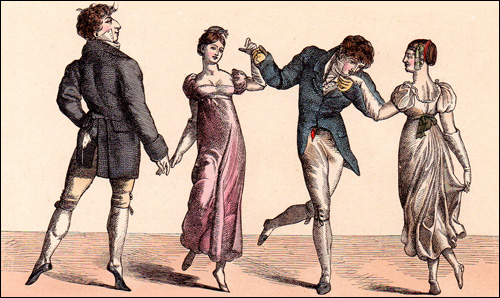
“A dance where the dancers of the different sexes stand opposite each other, instead of a side by side, as in the minuet, rigadoon, louvre, etc. and now corruptly called a country dance.”
From mental_floss magazine. The earliest source used in this article is from 1840, but many of these rules applied to Regency ladies and gentlemen as well.
Etiquette was a booming business in the 19th-century. Industrialization meant that people were moving between places and classes in a way they hadn’t before, and there was a great demand for guidance on how to fit into the social circles that they had either gotten themselves into, or wanted to get into. Hundreds of etiquette books were published in this period, and they all had something to say about how to use language. Here are 18 perfectly charming rules on how to converse properly culled from 19th century etiquette books.
Some of the rules are quite sensible. For example, don’t be a jerk, a pretentious jerk, or a teenager.
1. “Don’t talk aloud in a railway carriage, and thus prevent your fellow passengers from reading their book or newspaper.”
2. “Don’t talk of ‘the opera’ in the presence of those who are not frequenters of it.”
3. “Don’t respond to remarks made to you with mere monosyllables. This is chilling, if not fairly insulting. Have something to say, and say it.”
Many of the rules are easier said than done. It takes a lot of concentration to keep your voice, meaning, and mysterious allure at the exact perfect level at all times.
4. “Always select words calculated to convey an exact impression of your meaning.”
5. “Don’t talk in a high, shrill voice, and avoid nasal tones. Cultivate a chest voice; learn to moderate your tones. Talk always in a low register, but not too low.”
6. “Avoid any air of mystery when speaking to those next to you; it is ill-bred and in excessively bad taste.”
You also need to choose your words carefully. Remember, your food is not healthy, you do not wear pants, and your wife is no lady.
7. “Don’t use meaningless exclamations, such as ‘Oh, my!’ ‘Oh, cracky’ etc.”
8. “Don’t say gents for gentlemen or pants for pantaloons. These are inexcusable vulgarisms. Don’t say vest for waistcoat.”
9. “Don’t speak of this or that kind of food being healthy or unhealthy; say always wholesome or unwholesome.”
10. “‘It made me quite low spirited; my heart felt as heavy as lead.’ We most of us know what a heavy heart is; but lead is by no means the correct metaphor to use in speaking of a heavy heart.”
11. “Don’t say lady when you mean wife.”
Acting things out is not funny—unless, of course, you are doing it to make fun of entire classes or nationalities.
12. “Never gesticulate in every day conversation, unless you wish to be mistaken for a fifth rate comedian.”
13. “A little graceful imitation of actors and public speakers may be allowed. National manners, and the peculiarities of entire classes, are fair game. French dandies, Yankee bargainers, and English exquisites, may be ridiculed at pleasure; you may even bring forward Irish porters, cab-drivers and bog-trotters—provided you can imitate their wit and humor.”
Ladies do not make good conversational partners.
14. “Never ask a lady a question about anything whatever.”
15. “In the company of ladies, do not labor to establish learned points by long-winded arguments. They do not care to take too much pains to find out truth.”
Which may have something to do with what’s in their etiquette books.
16. “Never question the veracity of any statement made in general conversation.”
17. “Men frequently look with a jealous eye on a learned woman … be cautious, therefore, in mixed company of showing yourself too much beyond those around you.”
Try conversing with them by eye instead.
18. “It may be coquettish, but there is nothing particularly womanly in never looking a man in the eye. Search the face that confronts you, and learn what manner of man this is whom you are receiving into your company and fellowship. If he quails under the inquisition, so much the worse for him. If he is worth looking at, it is a pity to miss the sight.”
Sources: Don’t: A manual of mistakes and improprieties more or less prevalent in conduct and speech, Oliver Bell Bunce, 1884; The Gentleman’s Book of Etiquette, Cecil Hartley, 1873; Martine’s Handbook of Etiquette and Guide to True Politeness, Arthur Martine, 1866; Etiquette for Ladies, Lea and Blanchard 1840; Etiquette: An answer to the riddle when? where? how? Agnes H. Morton, 1899.
Read this and other articles here: http://mentalfloss.com/article/49961/how-converse-properly-18-tips-old-etiquette-books#ixzz2YTko3Jgp
Not the fastest horse can catch a word spoken in anger.
–Chinese Proverb
http://www.merriam-webster.com/dictionary/proverb
Our Friday Favorite this week comes to us from Brian Cushing, a Regency period re-enactor who gives workshops and talks about gentlemen’s dress in the early 19th century. This video is taken from his demonstration at Burdett’s Tea Shoppe in Springfield, TN. Mr. Cushing begins with the outermost layer of clothing and works his way inward, explaining the function and development of each piece as he goes–great for those of you who like visual aides!
“To sway away on all top ropes; to live riotously or extravagantly.”
Ever hear of Flat Stanley? He’s a character in a children’s story who accidentally gets flattened when a cork board falls on him. He then takes advantage of his two-dimentional-ness to slide underneath doors and go places no one else can.
–
In 1994, a man named Dale Hubert thought it would be fun if children created their own Flat Stanleys and mailed them to friends and family all over the world. The receiving families would “host” the Stanleys, showing them around town and keeping a journal about the places they’d gone. When the “visit” was over, the receiving family would mail the Stanleys back to their owners, along with the journals. Children could learn about other places in the world in an authentic, non-textbook sort of way. And thus the Flat Stanley Project was born.
I thought it would be entertaining to have a Flat Stanley for the historically-minded, one to take with me on my (admittedly few) travels. Since I’m writing a Regency-era novel, I wanted a prominent, recognizable figure from that time period. It also made sense to continue the theme and use a person who had traveled extensively during his or her lifetime. I settled on Sir Arthur Wellesley, 1st Duke of Wellington, who I was familiar with…and who would look good on camera 🙂

I cut him out and pasted him to some sturdy cardboard to help him survive his journeys. Then I packed him in my suitcase and took him to the Historical Novel Society’s 2013 Conference in St. Petersburg, Florida.
We spent most of our time at the hotel, the beautiful Renaissance Vinoy. Photo credit goes to Margaret Rodenberg, who stepped in with her camera when mine threw a tantrum. Thanks Margaret!

His Grace was also kind enough to come with me to my Blue Pencil Cafe appointment, where I had the first two pages of my WIP critiqued by the lovely Kris Waldherr. He was supposed to give us privacy, but I think he was eavesdropping–listening for his own name, perhaps?

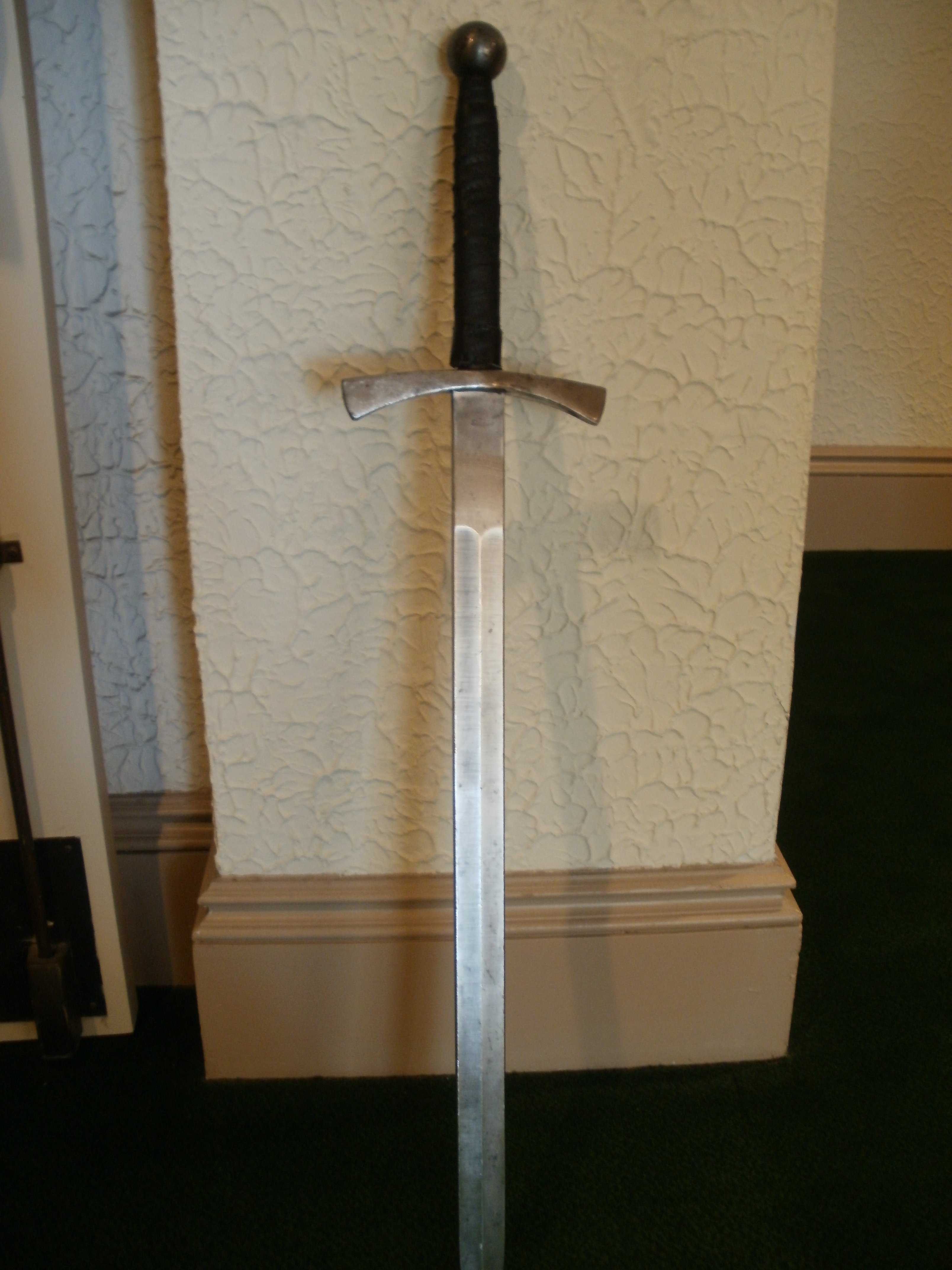
I did not take him with me to David Blixt‘s sword fighting workshop, mostly because I didn’t want to hear him prattle on about his own prowess. Or how my form was wrong. Or how the exit sign that I nearly decapitated never did anything to me. Since I ended up with a nice medieval broadsword rather than a rapier or smallsword (which he’d be more familiar with), His Grace probably wouldn’t have been too critical. But I think he enjoyed his quiet time in the hotel room. I certainly enjoyed the workshop!
We did take a walk together, though, on the last day of the conference, and talked over our experiences in this pretty little park across the street.

Sitting on a bench in the shade, I asked His Grace if he had enjoyed his stay in St. Petersburg. He told me it wasn’t bad–better than his last trip to Spain. But he wished we’d gotten out more, seen more of the town than just the hotel and the park.
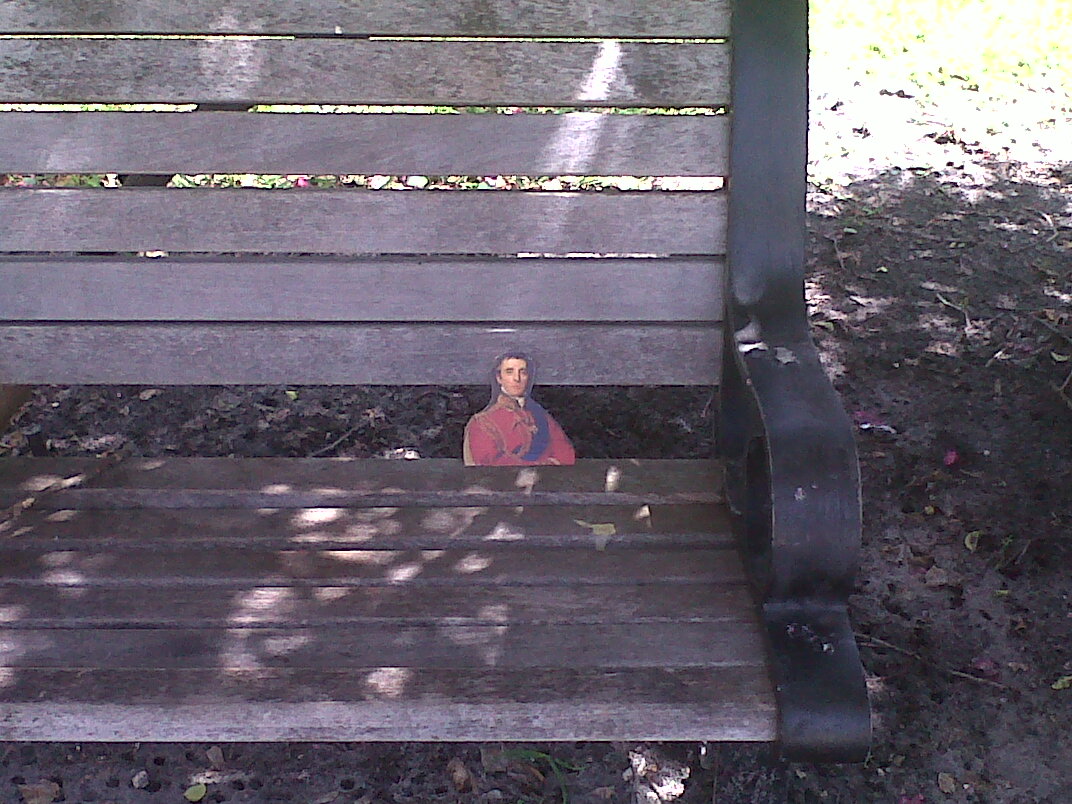
Maybe you can help, my wonderful readers! Are you going to a conference or convention involving history or writing? Taking a trip to a historic place with the family? Researching for school, work, or pleasure? Perhaps you could make a Flat Arthur of your own, and take him with you 😀
 Cora Lee, Regency Romance Author