Fashion

HNS Costume Pageant: Party Like It’s 1599

…or in my case, like it’s 1813 🙂

OLYMPUS DIGITAL CAMERA

I must make a confession to you this week: I would have been a miserable failure amongst the ton. I’m practically the definition of bluestocking, for one thing. I also have brown hair and freckles (skillfully covered by good powder in my profile pic). I’m descended from a long line of laborers, tradesmen, and those who work for a living.

And I have very little fashion sense.

I make a good effort in the classroom, because if I look foolish or frumpy my teenaged students will focus on my clothing instead of the lesson. I’m careful not to look ragged when I go out in public, too—mostly because I live in the same area as my students, but it’s also good practice for when I’m a huge, famous author 🙂

These last months, though, I’ve been focusing on Regency fashion. The Historical Novel Society is having their annual conference this coming weekend (which I’m attending), and one of their events is a costume pageant (which I absolutely had to participate in). But how does one put together a 200-year-old outfit in a tiny little town?

A lot of people dig up an old pattern, and put needle and thread to fabric. But my sewing skills are limited to reattaching buttons, so I hit the internet looking for costume shops. I found Matti’s Millinery and Costumes, a store run by a pair of ladies who do costume work for theater groups and reenactors. The have medieval and renaissance wear, Victorian and Edwardian pieces, and a big old section of Regency gear.

After some careful consideration, I settled on a beautiful copper-colored satin evening gown, with an embroidered net overdress (pictured in it’s entirety above, bodice detail below). It’s got the empire waist typical of the Regency, the long flowing skirt (no panniers or bustle to mar the smooth line—or make moving difficult). It’s not the white or pastel that a young miss would wear (because, let’s face it, at my age in that time period, I’d be firmly on the shelf).

OLYMPUS DIGITAL CAMERA

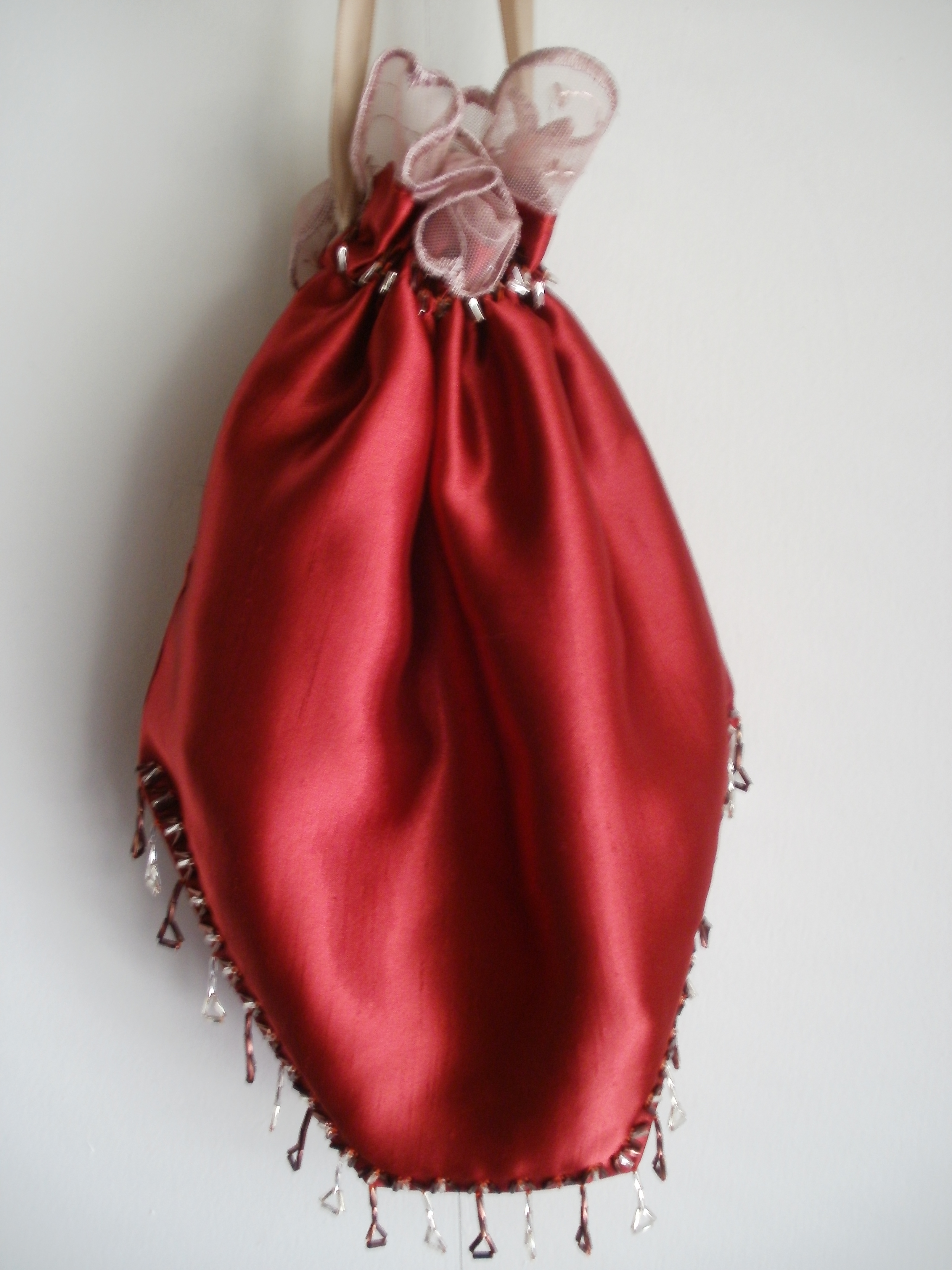
Then, just as now, a lady’s ensemble wasn’t complete without a handbag, and the wonderful ladies at Matti’s made one for me out of material left over from the gown. It’s large enough to hold all my 21st Century things (camera, business cards, lip balm, medication, etc), but totally period appropriate.
OLYMPUS DIGITAL CAMERA

I even hunted down a pair of gloves that weren’t made of stretchy nylon, or intended for wear by girls going to prom. I didn’t want white gloves, either—while rather ubiquitous, everything about my dress is shades of copper and tan, and I think white would have looked out of place. But I found this lovely pair of beige evening gloves from the early 1960s on e-bay. They arrived in rather appalling condition, but cleaned up nicely.

OLYMPUS DIGITAL CAMERA

I’m not wearing period appropriate shoes (my black flats from Payless will have to do this time), nor am I wearing silk stockings (not in Florida in late June). So the only thing left is to figure out what to do with my hair. And here I’m stuck. My hair is too long (and frizzy in the humidity) to leave down, but it’s too short for an elaborate updo (see my profile picture). And I’ll have to be able to do it myself (eek!).

Suggestions?

Uncategorized

Please Allow Me to (Re)Introduce Myself

It’s been a while since I posted to this blog on a regular basis, and I’m afraid I never introduced myself properly in the first place. Oh, sure, there’s the “official” bio on the About page, and all my contact links appear if you click on my picture to the left. But that’s only a small part of who I am.

By day I am a high school teacher—not in English or in History, as most people would assume, but in Mathematics and Psychology. I majored in History because I Quantum_Calculations_by_throttledanloved it (still do, more than any other subject). But by the time I realized my place in the world was in a classroom, I had half of an engineering degree completed…including a whole bunch of math. And so I’ve been teaching high school math for the last 10 years. Psychology was kind of an accident–it was part of the position when I applied, and no one wants to take it over. I’m okay with that, though, because it’s actually a really fun class! And I can’t even count how many times I’ve had an insight into one of my characters while teaching a lesson.

By night—and on weekends, school vacations, and over the summer—I’m a writer. I love books of all kinds, and get ideas in a bunch of different genres, but my Leonid_Pasternak_001specialty is historical romance. Right now I’m working on the first book in a Regency series that focuses on three brothers and their attempts (consciously done or otherwise) to reunite with the women they loved, but lost. Some parts (mostly the big things) are progressing well. Some parts (mostly the little details) are taking forever. I have no representation or publisher, just two wonderful critique partners and a fabulous circle of friends who support me as I muddle through 🙂

At all times, I’m a patient with three chronic illnesses. I have doctors and medications to help me along and regulate many of my symptoms, but one thing I never seem to have enough of is energy. Most of it is spent at school with myDoctors_stethoscope_1 students, their parents, and my fellow educators. Tasks are prioritized not just by due date, but by size and the amount of effort required of me for each one. I’m very careful to watch my schedule, weighing each invitation and event against the big picture, and what it will cost me physically to go. I write more slowly, don’t devote as much time to social media, take longer to research things because of my health. But when I get published, the victory will be all the sweeter because I worked so hard to get there.

Most of my posts here will be history-related, focusing on the Regency period (because that’s what I’m writing) but including anything else I find interesting. Some posts will deal with writing, or the life of an as-yet-unpublished writer. Occasionally I’ll post about other things: school, my personal life, my illnesses, sports, Psychology, how the hero of my first novel is like Batman (yes, really!). Whatever the subject, I hope to inform and entertain. And I hope you’ll keep coming back for more 😀

Marriage

You Bastard! Illegitimacy During the Regency

Because I had to rein myself in last week replying to Barbara’s comment, and because I can use one of my favorite characters as an example (see if you can guess which one it is), this week’s blog post is about legitimacy (or the lack thereof).

In order to be considered a legitimate child during the Regency, your parents had to be married at the time of your birth.  It didn’t matter what their status was at your conception, as long as they made it to the altar—together—before you made an appearance in the world.  If you came before the nuptial ceremony, you were illegitimate, forever, even if your parents married later*.

If your mother was married to another man at the time of your birth, you were legitimate, but legally the child of her husband.  There are all kinds of subtle (and sometimes not so subtle) jokes and references in Regency and Georgian novels about ladies letting a “cookoo” in the nest—passing off the child of an affair as one belonging to her husband.  It’s even a major plot point in Julia Quinn’s It’s In His Kiss: the hero and his “father” both know he’s the product of his mother’s affair, but he’s still the legal heir to his “father’s” title and fortune.

Illegitimate offspring could not inherit titles or entailed property (property that, by law, passed to the next legitimate male heir).  Ever.  They could inherit unentailed property (property that could be disposed of in any manner), money, or goods by will—as could anybody else.

A great example of this is Mary Balogh’s A Secret AffairThe hero, Constantine Huxtable, was born two days before his parent’s wedding, thus rendering him ineligible to inherit his father’s earldom (this is actually the basis for the series, as a cousin inherits instead).  But wait, you say.  Grace Burrowes has a hero who’s illegitimate, and he’s an earl!  In The Soldier, Devlin St. Just is the bastard son of a duke, and he does gain an earldom, but not through inheritance. St. Just’s title was granted for service to the Crown during the Napoleonic Wars, and it was the monarch’s prerogative to confer the honor.  (Where do you think all those nobles came from in the first place?)

Bastardy was also a bar to society, for the most part.  According to Allison Lane, an illegitimate daughter was not accepted or welcome at all socially, while a son could be admitted to the fringes of society with the help and sponsorship of his father.  The heroine of Julia Quinn’s An Offer from a Gentleman is a good illustration: she was the bastard daughter of an earl, but never acknowledged as anything other than the earl’s ward, nor did she move in society (except once, but I won’t spoil it for you).

There were exceptions to this rule (there always are, right?), and a big one was William, Duke of Clarence (later William IV) had ten (yes, ten!) illegitimate children with an actress known as Mrs. Jordan.  Being the bastard get of a royal duke was clearly a better lot than that of other illegitimate children (and many legitimate ones, too).  Since their father was the son and brother of a king (then later a king himself), the FitzClarences, as they were called, did well socially.  They were given the precedence of the children of a marquess, the eldest son was granted an earldom, and the rest married nobles or the children of nobles.

*For those of you that are familiar with the medieval period, you’re probably jumping up and down right now, yelling “John of Gaunt!” or “Beaufort!” (or maybe you’re yelling something else at me!).  Yes, John of Gaunt (son of Edward III) had four children with his mistress Katherine Swynford and given the surname Beaufort (after one of John’s properties).  And yes, they were eventually legitimized by the pope and their cousin Richard II when John scandalized everyone and married Katherine (their children were adults by then).  But this was under the medieval Catholic Church, where rules could be bent for the right price, and John was a very powerful man.  And this legitimacy was questioned a couple of generations later when Henry Tudor, great-great-grandson of John through his eldest Beaufort son, claimed the English throne.  The Regency was several hundred years after the Reformation, andBritain’s aristocracy was (for the most part) steadfastly Protestant.  Different time, different church, different rules.

Marriage

Annulments: 99 Problems, But A Wife Ain’t One

After reading Regina Jeffer’s blog post about the rules of marriage in Regency England last week, I started thinking about ways to dissolve a marriage (I know, ever the optimist, aren’t I?) during the period.

Marriages of convenience show up in romance novels of all types, usually with the understanding that the couple can part ways after their union is no longer useful.  In Regency romances, I’ve seen a lot of marriages dictated by a will (as in “you must marry by a certain age/time frame or you will lose your inheritance”), and marriage to one person to escape marrying another (often a “my father wants me to marry this horrible, old man, and I don’t want to” sort of thing, though sometimes it’s a prospective groom who is being hounded to marry a woman of his family’s choosing).  They always say, “We can get an annulment later.”

Of course, they don’t–they fall in love and decide to stay married.  But while they’re falling in love, the newly wed couple is usually trying to preserve a situation where an annulment could be granted.  And while annulments are certainly possible during the Regency, they were only obtainable under certain circumstances.

–>Fraud: a participant in the wedding used a fake name or anything short of his/her full legal name (including all titles) OR a promise was made in the marriage contract that cannot be kept.  Though, in the case of a misused name—say a nobleman forgot to include one of his multitude of titles on the register—the presiding authority can decline to issue the annulment and simply correct the register.

–> Incompetence: a participant in the wedding was under 21 (a legal minor) and did not have consent of his/her legal guardian (your father, if he was still alive) OR insanity (which tainted the entire family–if one of you is insane, what about the rest?)

–>Impotence: the physical incapability of a man to have intercourse, not the abstinence from it.  Doctors became involved, and, according to Allison Lane, the use of very skilled courtesans!  (Mary Jo Putney’s The Bargain—previously title The Would-Be Widow—does a pretty good job with this, and though her method does not match what Allison has described, it’s a logical process…minus the courtesans 😉

Divorce was even more difficult, a long process that involved civil courts, ecclesiastical courts, and the House of Lords.  It was very messy, very public, and very expensive.  A divorced man’s reputation was basically trashed, though he might be able to find some acceptance somewhere (the hero of Laura Lee Guhrke’s And Then He Kissed Her—the inspiration for the name of this blog [though I haven’t finished the book yet!]—is divorced at the start of the story).  A divorced woman was pretty much cast out of society, ruined beyond repair.

For more details and examples, check out Allison Lane’s Common Regency Errors page.  She has some great information on inheritance of properties and titles, and a wonderful section about forms of address for titled nobles and their families.

Regency

What is the Regency?

When I first started working on my novel, I was intelligent enough to ask a good friend of mine (who is an excellent writer in her own right and a British subject to boot) if she would please, please, please be my beta reader.  I let her know that the story was set during the Regency era, and asked how much she knew about that period of time.  She replied that she knew there was a Regency era in British history, but that was all.

That, of course, is not a slight on her intelligence (because I secretly think she’s smarter than me), but it occurred to me that a lot of people might not know much about the period beyond the shirtless man on the cover of the historical romance they saw at the bookstore.  It also occurred to me that an introduction to the period would make a good introduction to this blog, but there are a lot of great articles already out there.  So rather than rehash what’s already been said, I’ve included links to some of the best articles I’ve found so far to get you started.

The teacher in me is yelling “No, no! It’s not a credible source!” but Wikipedia has a good article on the British Regency, complete with a timeline, lists of important people, places, and publications.  There are also some nice images for the visual learners among us—the Frost Fair  picture reminds me of a pack of ice fishing shanties.

Greenwood’s 1827 map of London  has been a big asset to me, both as a read and a writer.  Click on any part of it to zoom in, then click again to zoom in further.

Here’s a beautiful website dedicated to the 95th Rifles, formed in 1803 as the first regiment to use rifles instead of the less accurate muskets.  They saw a lot of action during the Peninsular/Napoleonic Wars.

Regency Romance novelist Candice Hern  has compiled a wonderful timeline running from 1788 through 1820 that gives more detail than the one listed in the Wikipedia article.  Political events, literary milestones, musical accomplishments, theater history, and social developments of the extended Regency can be found here in chronological order, color coded by category.

This is a nice article by Michelle Jean Hoppe  that talks about the London Season.  I like it because it’s not too long, but it’s well written and gives you enough detail to be worth reading.

These are just a few of the websites I’ve frequented.  What other good websites are out there for the Regency period?  What are your favorites?