Contra Dance
“A dance where the dancers of the different sexes stand opposite each other, instead of a side by side, as in the minuet, rigadoon, louvre, etc. and now corruptly called a country dance.”
“A dance where the dancers of the different sexes stand opposite each other, instead of a side by side, as in the minuet, rigadoon, louvre, etc. and now corruptly called a country dance.”
From mental_floss magazine. The earliest source used in this article is from 1840, but many of these rules applied to Regency ladies and gentlemen as well.
Etiquette was a booming business in the 19th-century. Industrialization meant that people were moving between places and classes in a way they hadn’t before, and there was a great demand for guidance on how to fit into the social circles that they had either gotten themselves into, or wanted to get into. Hundreds of etiquette books were published in this period, and they all had something to say about how to use language. Here are 18 perfectly charming rules on how to converse properly culled from 19th century etiquette books.
Some of the rules are quite sensible. For example, don’t be a jerk, a pretentious jerk, or a teenager.
1. “Don’t talk aloud in a railway carriage, and thus prevent your fellow passengers from reading their book or newspaper.”
2. “Don’t talk of ‘the opera’ in the presence of those who are not frequenters of it.”
3. “Don’t respond to remarks made to you with mere monosyllables. This is chilling, if not fairly insulting. Have something to say, and say it.”
Many of the rules are easier said than done. It takes a lot of concentration to keep your voice, meaning, and mysterious allure at the exact perfect level at all times.
4. “Always select words calculated to convey an exact impression of your meaning.”
5. “Don’t talk in a high, shrill voice, and avoid nasal tones. Cultivate a chest voice; learn to moderate your tones. Talk always in a low register, but not too low.”
6. “Avoid any air of mystery when speaking to those next to you; it is ill-bred and in excessively bad taste.”
You also need to choose your words carefully. Remember, your food is not healthy, you do not wear pants, and your wife is no lady.
7. “Don’t use meaningless exclamations, such as ‘Oh, my!’ ‘Oh, cracky’ etc.”
8. “Don’t say gents for gentlemen or pants for pantaloons. These are inexcusable vulgarisms. Don’t say vest for waistcoat.”
9. “Don’t speak of this or that kind of food being healthy or unhealthy; say always wholesome or unwholesome.”
10. “‘It made me quite low spirited; my heart felt as heavy as lead.’ We most of us know what a heavy heart is; but lead is by no means the correct metaphor to use in speaking of a heavy heart.”
11. “Don’t say lady when you mean wife.”
Acting things out is not funny—unless, of course, you are doing it to make fun of entire classes or nationalities.
12. “Never gesticulate in every day conversation, unless you wish to be mistaken for a fifth rate comedian.”
13. “A little graceful imitation of actors and public speakers may be allowed. National manners, and the peculiarities of entire classes, are fair game. French dandies, Yankee bargainers, and English exquisites, may be ridiculed at pleasure; you may even bring forward Irish porters, cab-drivers and bog-trotters—provided you can imitate their wit and humor.”
Ladies do not make good conversational partners.
14. “Never ask a lady a question about anything whatever.”
15. “In the company of ladies, do not labor to establish learned points by long-winded arguments. They do not care to take too much pains to find out truth.”
Which may have something to do with what’s in their etiquette books.
16. “Never question the veracity of any statement made in general conversation.”
17. “Men frequently look with a jealous eye on a learned woman … be cautious, therefore, in mixed company of showing yourself too much beyond those around you.”
Try conversing with them by eye instead.
18. “It may be coquettish, but there is nothing particularly womanly in never looking a man in the eye. Search the face that confronts you, and learn what manner of man this is whom you are receiving into your company and fellowship. If he quails under the inquisition, so much the worse for him. If he is worth looking at, it is a pity to miss the sight.”
Sources: Don’t: A manual of mistakes and improprieties more or less prevalent in conduct and speech, Oliver Bell Bunce, 1884; The Gentleman’s Book of Etiquette, Cecil Hartley, 1873; Martine’s Handbook of Etiquette and Guide to True Politeness, Arthur Martine, 1866; Etiquette for Ladies, Lea and Blanchard 1840; Etiquette: An answer to the riddle when? where? how? Agnes H. Morton, 1899.
Read this and other articles here: http://mentalfloss.com/article/49961/how-converse-properly-18-tips-old-etiquette-books#ixzz2YTko3Jgp
Not the fastest horse can catch a word spoken in anger.
–Chinese Proverb
http://www.merriam-webster.com/dictionary/proverb

Our Friday Favorite this week comes to us from Brian Cushing, a Regency period re-enactor who gives workshops and talks about gentlemen’s dress in the early 19th century. This video is taken from his demonstration at Burdett’s Tea Shoppe in Springfield, TN. Mr. Cushing begins with the outermost layer of clothing and works his way inward, explaining the function and development of each piece as he goes–great for those of you who like visual aides!
“To sway away on all top ropes; to live riotously or extravagantly.”
Ever hear of Flat Stanley? He’s a character in a children’s story who accidentally gets flattened when a cork board falls on him. He then takes advantage of his two-dimentional-ness to slide underneath doors and go places no one else can.
–
In 1994, a man named Dale Hubert thought it would be fun if children created their own Flat Stanleys and mailed them to friends and family all over the world. The receiving families would “host” the Stanleys, showing them around town and keeping a journal about the places they’d gone. When the “visit” was over, the receiving family would mail the Stanleys back to their owners, along with the journals. Children could learn about other places in the world in an authentic, non-textbook sort of way. And thus the Flat Stanley Project was born.
I thought it would be entertaining to have a Flat Stanley for the historically-minded, one to take with me on my (admittedly few) travels. Since I’m writing a Regency-era novel, I wanted a prominent, recognizable figure from that time period. It also made sense to continue the theme and use a person who had traveled extensively during his or her lifetime. I settled on Sir Arthur Wellesley, 1st Duke of Wellington, who I was familiar with…and who would look good on camera 🙂
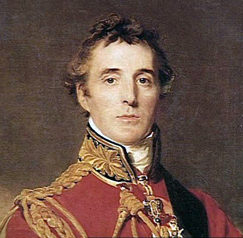
I cut him out and pasted him to some sturdy cardboard to help him survive his journeys. Then I packed him in my suitcase and took him to the Historical Novel Society’s 2013 Conference in St. Petersburg, Florida.
We spent most of our time at the hotel, the beautiful Renaissance Vinoy. Photo credit goes to Margaret Rodenberg, who stepped in with her camera when mine threw a tantrum. Thanks Margaret!

His Grace was also kind enough to come with me to my Blue Pencil Cafe appointment, where I had the first two pages of my WIP critiqued by the lovely Kris Waldherr. He was supposed to give us privacy, but I think he was eavesdropping–listening for his own name, perhaps?

I did not take him with me to David Blixt‘s sword fighting workshop, mostly because I didn’t want to hear him prattle on about his own prowess. Or how my form was wrong. Or how the exit sign that I nearly decapitated never did anything to me. Since I ended up with a nice medieval broadsword rather than a rapier or smallsword (which he’d be more familiar with), His Grace probably wouldn’t have been too critical. But I think he enjoyed his quiet time in the hotel room. I certainly enjoyed the workshop!
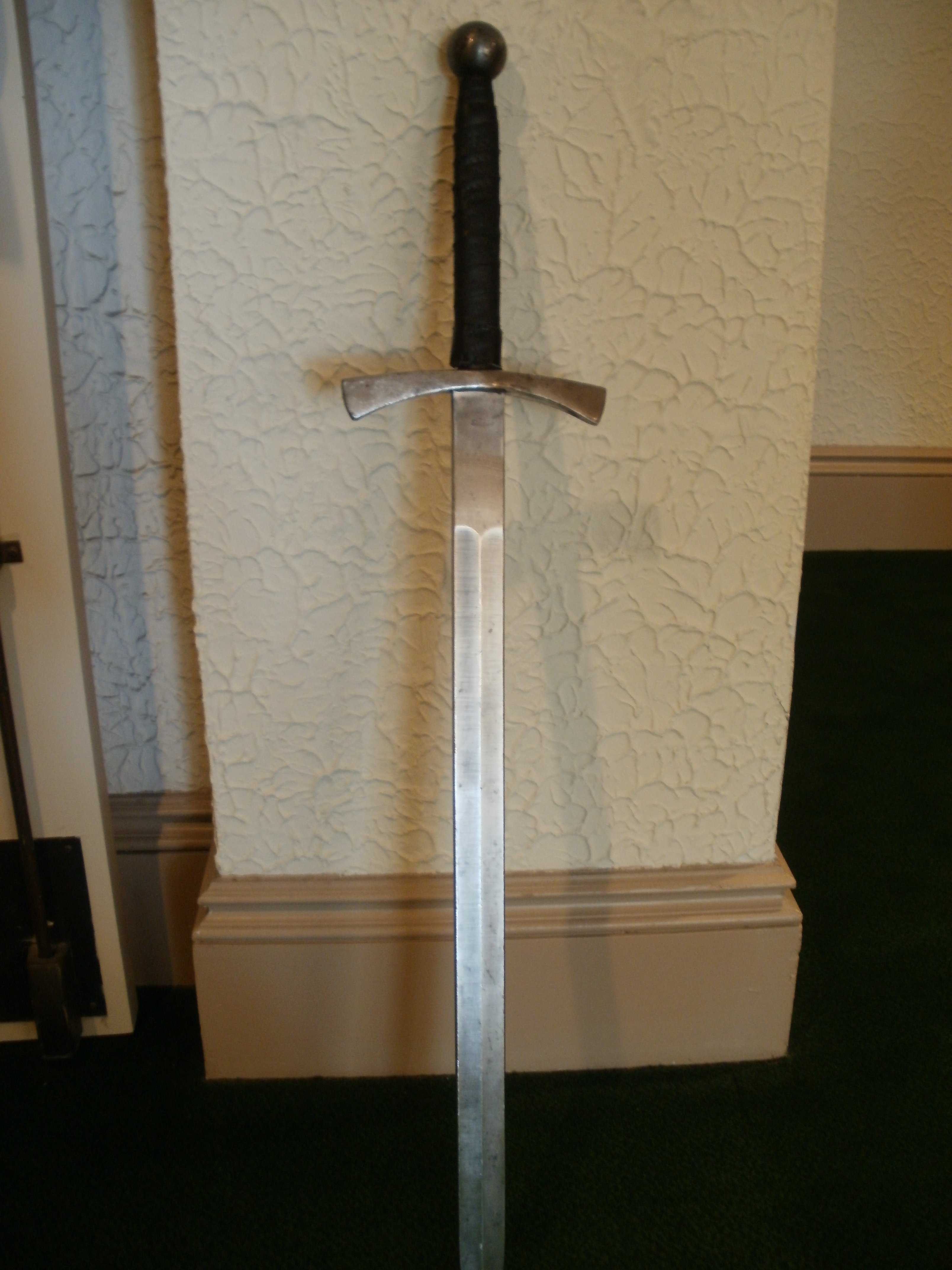
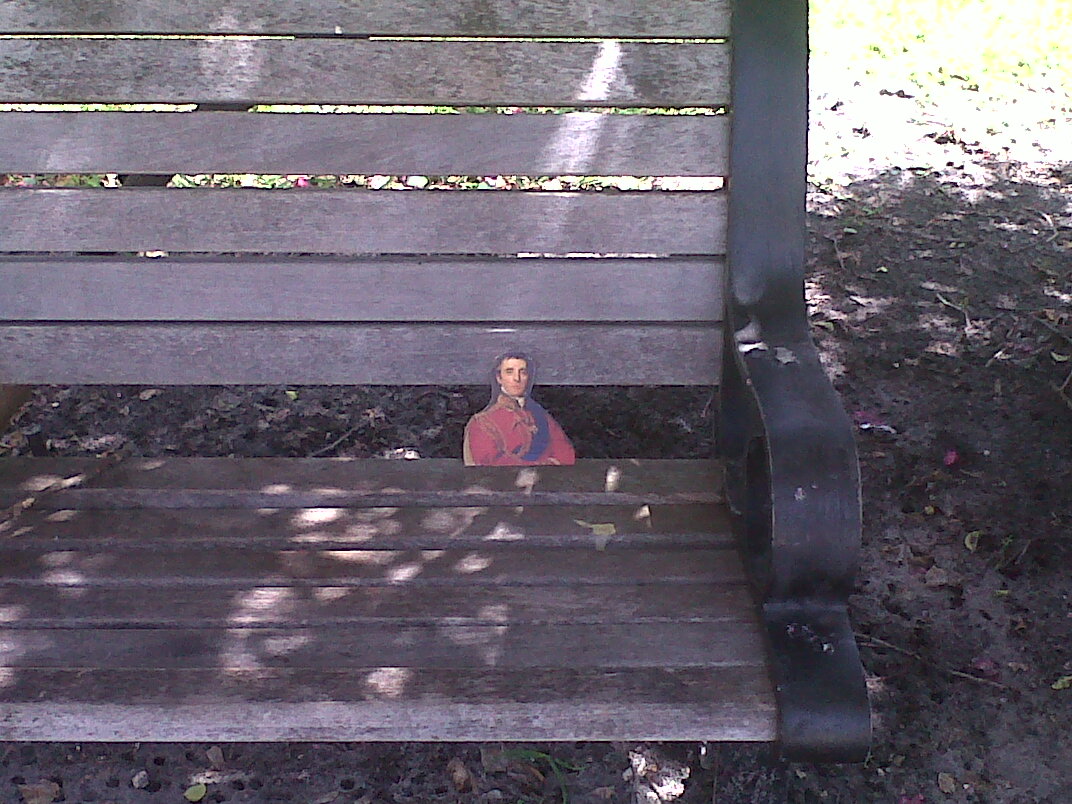
We did take a walk together, though, on the last day of the conference, and talked over our experiences in this pretty little park across the street.

Sitting on a bench in the shade, I asked His Grace if he had enjoyed his stay in St. Petersburg. He told me it wasn’t bad–better than his last trip to Spain. But he wished we’d gotten out more, seen more of the town than just the hotel and the park.
Maybe you can help, my wonderful readers! Are you going to a conference or convention involving history or writing? Taking a trip to a historic place with the family? Researching for school, work, or pleasure? Perhaps you could make a Flat Arthur of your own, and take him with you 😀
Moral excellence comes about as a result of habit. We become just by doing just acts, temperate by doing temperate acts, brave by doing brave acts.
–Aristotle
http://www.ucmp.berkeley.edu/history/aristotle.html
Officially titled The Year 1812 Festival Overture in E-flat major, Op. 49, the 1812 Overture was composed by Pyotr Ilyich Tchaikovsky in 1880. Tsar Aleksander I had commissioned a church to be built commemorating Russia’s victory over Napoleon in 1812, and the church was nearing completion. Big festivities were planned, but derailed when Tsar Aleksander II was assassinated in March 1882. (The piece was eventually performed, but indoors with a conventional orchestra.)
Written for outdoor performance with pealing bells and live cannon fire, the Overture is a musical war between la Marseillaise (representing Napoleon’s French army) and God Save the Tsar (representing the Russian Empire). The French national anthem is strong in the beginning, but is beaten back as the piece moves, drown out by the cathedral bells, cannon, and the Russian national anthem. (Interestingly enough, neither anthem was in use at the time of the actual battle.)
Have a listen and see if you can pick them out:
Here’s the entire Overture for the musically adventurous among you:
Here in the US, we use the 1812 Overture to celebrate our own Independence Day, which seems strange given the original purpose of the music. This article in the Pittsburgh Post-Gazette posits a theory as to why.
“The fashionable theme, the go. The Crack Lay, of late is used, in the cant language, to signify the art and mystery of house-breaking.”
Written by Jacqueline Diamond, whose half-dozen traditional Regency romances, now available as ebooks, include Rita Award finalist THE FORGETFUL LADY as well as LADY IN DISGUISE and A LADY OF LETTERS. Published in the Regency Reader, July 2013.
Since people suffered from visual defects in earlier centuries just as they do now, it should be no surprise that, throughout the ages, inventors, artisans, jewelers and glassmakers put their talents to use improving our ability to see.
The earliest known use of lenses to aid vision was in ancient Egypt and Assyria, where people were depicted using magnifying stones such as polished crystals. In the first decade B.C., Roman philosopher Seneca used water-filled objects to magnify text for reading.

Around the year 1000 A.D., Muslim scholar Alhazen (965-1040)-known as the father of modern optics-wrote a seven-volume treatise on the subject. In the late 12th century, Marco Polo claimed that eyeglasses were popular among the wealthy Chinese. The demand for spectacles grew dramatically by the end of the 15th century, thanks to the invention of the printing press and the much wider availability of reading material.
Here are some good sites about ancient glasses:
http://optical.com/eyeglasses/history-of-eyeglasses/
http://www.antiquespectacles.com/history/ages/through_the_ages.htm
http://io9.com/strange-and-wonderful-moments-in-the-history-of-eyeglas-507302709
My own myopia inspired me, for my sixth traditional Regency romance, to create a nearsighted heroine. In A Lady’s Point of View, Meg Linley–forbidden by her mother to wear eyeglasses–accidentally causes a scandal by cutting Beau Brummell at a ball. Then, sent home in disgrace, she gets into the wrong carriage and is mistaken for a governess.
In 1989, when Harlequin published the novel, I had to dig through books for a few snippets of information on eyeglasses during the Regency. Imagine my delight, when preparing the recent ebook release, at finding a treasure trove of information on the Internet.
Here’s a look at the situation that would have affected my heroine:
An English optician, Edward Scarlett (1677-1743), is credited with developing eyeglasses that rest on the nose and ears. While the exact origin of bifocals is debated, Benjamin Franklin usually gets the credit. Bifocals were found in London after the 1760s.
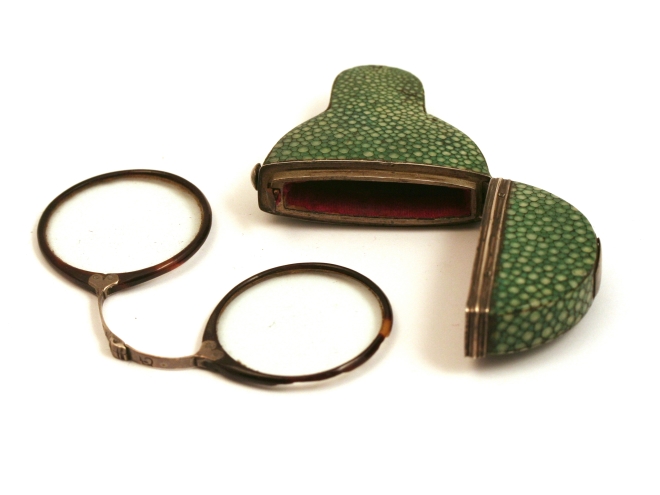
However, glasses weren’t considered fashionable by the Regency upper crust. Instead, the Beau Monde preferred the quizzing glass, a magnifying lens with a handle that the user peered through.
Quizzing glasses remained popular until the 1830s, when the lorgnette gained in popularity, especially among women. First appearing between 1795 and 1805, the lorgnette is a pair of lenses with a short handle. Also known as opera glasses, these derived their name from the French word lorgner, to ogle.
The quizzing glass was usually set with a magnifying lens, although in some cases a corrective lens was used. Goldsmiths or jewelers provided the frames, often made of gold or sterling silver, with elaborate designs. These hung from a chain attached to the handle-of varying lengths-or loop.
For charming pictures of eyewear from the Regency, I recommend these sites:
http://historicalhussies.blogspot.com/2010/08/regency-glasses-and-eyeware.html
http://candicehern.com/collections/04/eyeglass.htm
 Cora Lee, Regency Romance Author