Love, love, love, that is the soul of genius.
–Wolfgang Amadeus Mozart

Love, love, love, that is the soul of genius.
–Wolfgang Amadeus Mozart
“Barbarous Latin, such as was formerly used b the lawyers in their pleadings.”
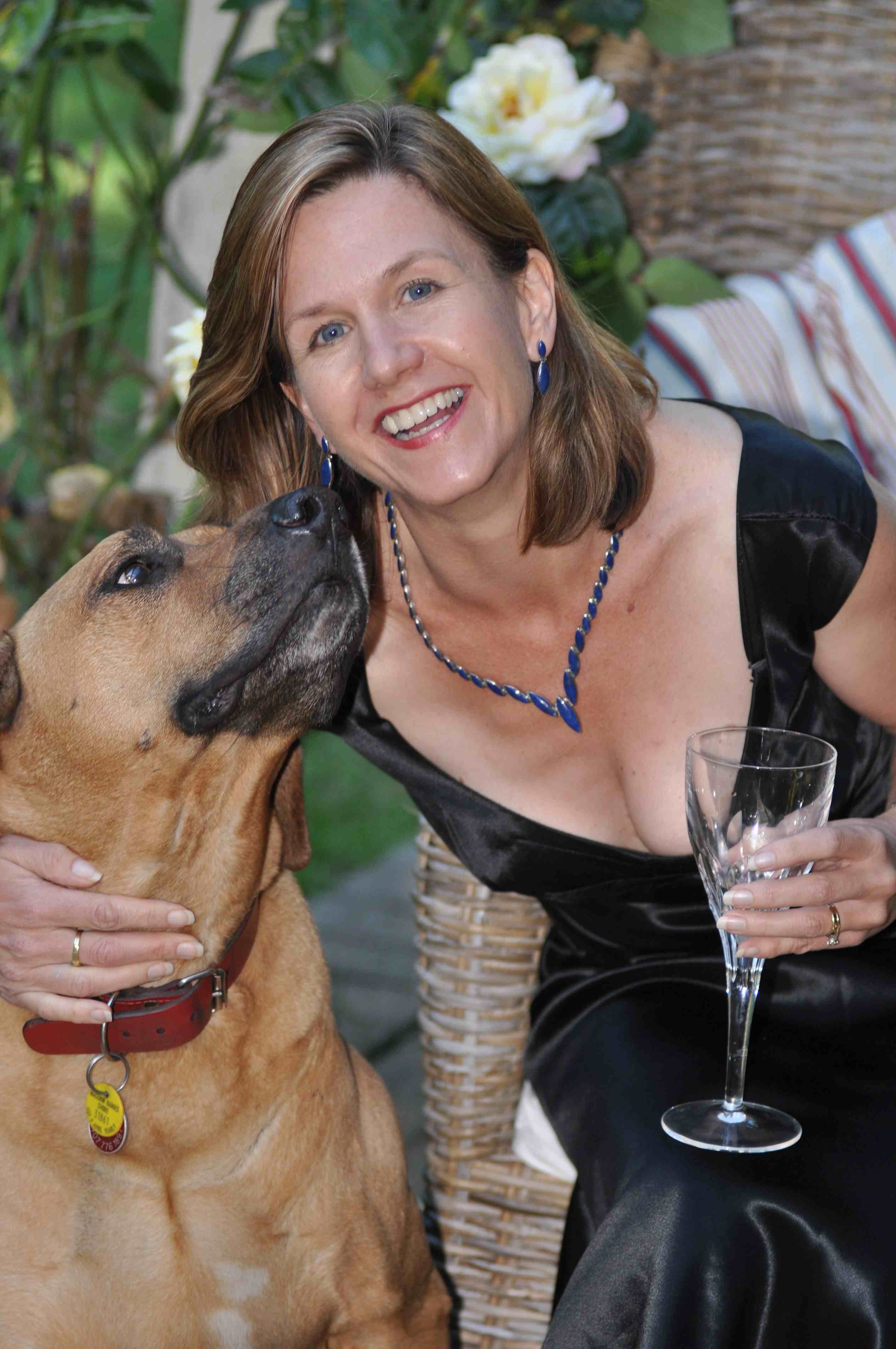
Beverley Oakley (aka Beverley Eikli) is the author of eight historical romances. Her suspenseful, Napoleonic espionage Romance The Reluctant Bride, has just been shortlisted by Australian Romance Readers for Favourite Historical in 2013.
Beverley wrote her first romance when she was seventeen. However, drowning the heroine on the last page was, she discovered, not in the spirit of the genre so her romance-writing career ground to a halt and she became a journalist.
After throwing in her job on South Australia’s metropolitan daily The Advertiser to manage a luxury safari lodge in the Okavango Delta, in Botswana, she discovered a new world of romance and adventure in a thatched cottage in the middle of a mopane forest with the handsome Norwegian bush pilot she met around a camp fire.
Twenty years later, after exploring the world in the back of Cessna 404s and CASA 212s as an airborne geophysical survey operator during low-level sorties over the French Guyanese jungle and Greenland’s ice cap, Eikli is back in Australia teaching in the Department of Professional Writing & Editing at Victoria University, as well as teaching Short Courses for the Centre of Adult Education and Macedon Ranges Further Education.
Sad Tales of ‘fallen women’ living in London’s Victorian Underworld
In London, in late November 2013, the discovery of three women held captive in a suburban home for thirty years made news headlines all over the world.
However there are dozens of similar instances of servitude recorded in an 1862 epic study entitled London’s Underworld compiled by Victorian-era investigative journalist and joint founder of Punch Magazine, Henry Mayhew. His first person reports of women and children who’d been ‘enticed’ and kept in unpaid servitude seem barely to have raised eyebrows nor to have been considered matters for police intervention at the time.
Mayhew estimated that in 1857 there were 80,000 prostitutes living in London, a figure far greater than the 8600 estimated by the London police.
As my Feb 12 Ellora’s Cave release Dangerous Gentlemen is about a viscount’s daughter who must pretend to be a prostitute to save her life, and who thus becomes embroiled in London’s Underworld, I thought I’d write a series of blog posts featuring individual accounts of the ‘fallen women’ Mayhew interviewed. These are girls from all walks of life who’d been seduced, kidnapped or otherwise tricked into a life servitude and prostitution and their accounts throw some light onto a world of hypocrisy we can only imagine.
So here’s an account of a young woman of twenty whom Henry Mayhew interviewed in a ‘respectable-looking’ house in a street running out of Langham Place.
‘What she told us was briefly this. Her life was a life of perfect slavery, she was seldom if ever allowed to go out and then not without being watched. Why was this? Because she would “cut it” if she got a chance, they knew that very well, and took very much care she shouldn’t have much opportunity.
Their house was rather popular, and they had lots of visitors; she had some particular friends who always came to see her. They paid her well, but she hardly ever got any of the money…. Where was she born? Somewhere in Stepney. What did it matter where; she could tell me all about it if she liked, but she didn’t care. It touched her on the raw- made her feel too much. She was ‘ticed when she was young, that is, she was decoyed by the mistress of the house some years ago. She met Mrs.—in the street, and the woman began talking to her in a friendly way.
Asked her who her father was (he was a journey-man carpenter), where he lived, extracted all about her family, and finally asked her to come home to tea with her. The child delighted at making the acquaintance of so kind and well dressed a lady, willingly acquiesced, without making any demur, as she never dreamt of anything wrong, and had not been cautioned by her father. She had lost her mother some years ago. She was not brought direct to the house where I found her? Oh! No. There was a branch establishment over the water, where they were broken in as it were. How long did she remain there? Oh! Perhaps two months, maybe three; she didn’t keep much account of how time went. When she was conquered and her spirit broken, she was transported from the first house to a more aristocratic neighbourhood. How did they tame her: Oh! They made her drunk and sign some papers, which she knew gave them great power over her, although she didn’t exactly know in what said power consisted, or how it might be exercised. Then they clothed her and fed her well, and gradually inured her to that sort of life. And now, was there anything I’d like to know particularly, because if there was, I’d better look sharp about asking it, as she was getting tired of talking, she could tell me. Did she expect to lead this life till she died? Well, she never did if I wasn’t going to preachify. She couldn’t stand that—anything but that.
What’s so sad about this and so many similar other accounts Mayhew documents is that the girl accepted she’d never be freed from her life of exploitation and servitude. Furthermore, Mayhew never even considered it a police matter. Nor was it, back then.
Henry Mayhew’s ‘London’s Underworld’ is filled with more than 400 pages of similar tales. The account above was the inspiration for the prostitute in my very first Regency Romance, Lady Sarah’s Redemption, published in 2009 under my Beverley Eikli name.
If you’re interested in reading other accounts of various ‘fallen women’ in Mayhew’s report, you can find a list of my Blog Tour stops on my website – http://www.beverleyoakley.com – or on my own blog – http://www.beverleyeikli.blogspot.com.au
They make poignant and fascinating reading.
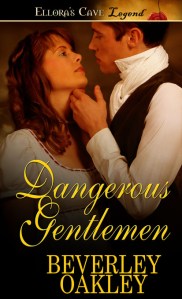
Dangerous Gentlemen, the sequel to Her Gilded Prison
Shy, self-effacing Henrietta knows her place—in her dazzling older sister’s shadow. She’s a little brown peahen to Araminta’s bird of paradise. But when Hetty mistakenly becomes embroiled in the Regency underworld, the innocent debutante finds herself shockingly compromised by the dashing, dangerous Sir Aubrey, the very gentleman her heart desires. And the man Araminta has in her cold, calculating sights.
Branded an enemy of the Crown, bitter over the loss of his wife, Sir Aubrey wants only to lose himself in the warm, willing body of the young “prostitute” Hetty. As he tutors her in the art of lovemaking, Aubrey is pleased to find Hetty not only an ardent student, but a bright, witty and charming companion.
Despite a spoiled Araminta plotting for a marriage offer and a powerful political enemy damaging his reputation, Aubrey may suffer the greatest betrayal at the hands of the little “concubine” who’s managed to breach the stony exterior of his heart.
A Romantica® historical Regency erotic romance from Ellora’s Cave
Beverley loves to hear from readers. You can find out more about her books at: http://www.beverleyoakley.com
Blog: http://www.beverleyeikli.blogspot.com.au
Twitter: @BeverleyOakley
Words, like nature, half reveal and half conceal the soul within.
–Alfred, Lord Tennyson
http://www.poets.org/poet.php/prmPID/300
This week’s Friday Favorite is a haven for history lovers and jewelry enthusiasts of all stripes. The Three Graces is an online jewelry store specializing in authentic period jewelry (including Georgian and Regency-era pieces), along with modern jewelry that reproduces or is inspired by pieces from the past. Here’s just one example:
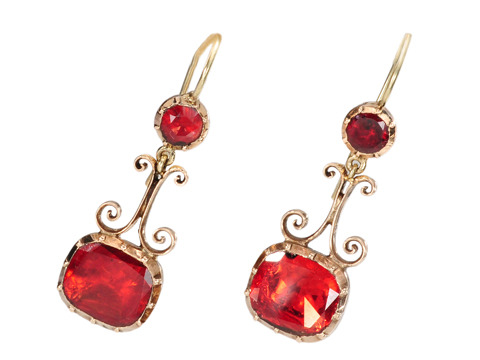
“Halley’s Comet jewelry is usually in the form of a small brooch almost always 1-1/4 inches (3.2 cm) or less in length. This fabulous jewel is a pair of matched earrings with that motif. Each of the fiery 10k yellow gold comets sport two (2) faceted natural garnets in crimped collet mounts. Typically Georgian in construction, the gems are foiled and set closed back.
Date: Circa 1835.”
For more period jewelry pieces, visit The Three Graces website.
For more information on Halley’s Comet jewelry, check out this post by Kyra Elliott for the Pennington Planetarium in Louisiana. Or this one at Art of Mourning.
“A country clodhopper: from the shoes of country farmers and ploughmen being commonly stuck full of hob-nails, and even often clouted, or tipped with iron.”
It is not time or opportunity that is to determine intimacy; it is disposition alone. Seven years would be insufficient to make some people acquainted with each other, and seven days are more than enough for others.
–Jane Austen
http://www.jasna.org/info/about_austen.html
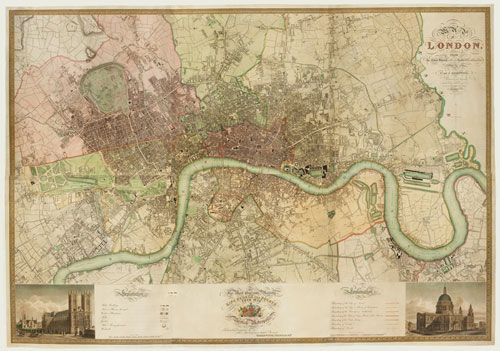
Our Favorite this week is a resource I’ve used countless times, both as a writer and a reader. It’s a clickable, interactive map of London originally published in 1827 and based on a survey of the city that took the previous two years. The scale is eight inches per mile, so the detail is amazing. And Bath Spa University (who hosts this particular version) has done a phenomenal job digitizing the map–you can zoom in several times and still get a beautifully clear picture.
Click the picture for more information:
“He is down in the black book, i.e. he has a stain on his character. A black book is keep in most regiments, wherein the names of all persons sentenced to punishment are recorded.”
Everyone has one. It’s nothing to be ashamed of…no matter how big it is. And mine is pretty huge.
It’s the TBR pile.
And I’m not talking about the books you merely want to read, I’m talking about the books you’ve already bought. The ones sitting in piles and bins and on shelves in your house. The ones in the TBR collection on your e-reader. The ones that have been sitting there for months.
How big is your pile?

Yes, I’m a writer. And someday before I die, I’d like to be a published writer. But I’m also a reader–not because reading will help to improve my writing (though it will), or so I can brag about how many books I’ve read in my life (a lot).
I read because I love reading.
I love reading so much I browse Amazon and B&N and the library looking for new books, even though I have so many in my possession already. So apparently I need a little structure–and a little support–in tackling the monstrous collection of books I haven’t yet read.
A blog I follow hosts a TBR Pile Challenge every year, complete with prizes for reviews and posts. But I missed the sign-up window, so I can’t participate.
Instead, I thought I’d have my own informal challenge, and see if anyone wanted to join me. These are the “rules” I’m going to use:
1. Choose the number of books from your TBR pile that you intend to read this year. I’m going with 12, not because my store of books is so small, but because I’m participating in a couple of Goodreads challenges, too, and I want to have time to write. Plus, some of the books on my shelves are big.
2. Books must owned by you for at least six months. This is the point of this challenge–to actually read the books that have been hanging around your shelves, bins, and e-readers waiting for you to notice them again.
3. I’ll check in with a post once a month to share how I’m doing. Anyone is welcome to comment and share their progress as well, whether you start with me now or pick up the cause in June or November. I’ve also created a Goodreads shelf to help keep track of my progress. Then all my challenges will be in one place–work smarter, not harder, right? 🙂
So who’s with me? Who’s going to finally go through those books at the bottom of the pile? Or the research books that went straight to the shelf? Or the e-books on your reader you bought with your gift cards last holiday season and forgot about?
Leave a comment here or on the TBR Challenge page with your commitment: how many books will you read from your TBR pile this year?
 Cora Lee, Regency Romance Author